| |
120. |
|
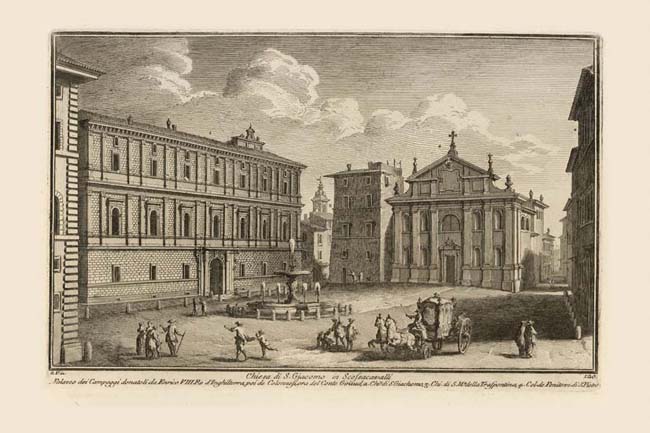
Chiesa di S. Giacomo in Scossacavalli |
|
 |
|
 |
|
 |
|
| |
1. |
Palazzo dei Campeggi donatogli da Enrico VIII Re d'Inghilterra, poi de Colonnesi ora dei Giraud |
| |
2. |
Chi.a di S. Giachomo |
| |
3. |
Chi. di S. M.a della Traspontina |
| |
4. |
Col. de Penitena. di S. Pietro |
This is one of the few available images depicting the late 16th century church of S. Giacomo (2). It was demolished by Mussolini in the 1930s along with most of the old Borgo including the "spina" or spine of buildings between the Borgo Vecchio (NN 1246) and Borgo Nuovo (NN 1247). The latter, built in 1500, was the first leg of the Via Papale, the papal processional route between the Vatican and the Lateran. In this function it replaced the Borgo Vecchio, the medieval Carreria Sancta. The controversial urban renewal project, evident in the satellite image, resulted in the creation of the broad Via Della Conciliazione which acts as a grand axis connecting the river and Castel S. Angelo with St. Peter's and its piazza. This modern boulevard, whose edge is partially defined by the late 15th century Palazzo Giraud (1) was intended to memorialize the "reconciliation" between the Italian state and the papacy which occurred in 1929 with the signing of the Lateran pact. The only buildings to survive that are visible in this print besides the Palazzo Giraud are the church of S. Maria Traspontina (3) and the Palazzo dei Penitenzieri (4). The fountain at the center of Piazza Scossacavalli, built under Paul V Borghese (1605-1621), was moved to a new space cleared in front of S. Andrea della Valle, Plate 134. One of the two wall fountains which were arranged symmetrically with the main fountain on the facade of Palazzo dei Penitenzieri, is barely visible at the right edge of the print.
|
