| |
134. |
|
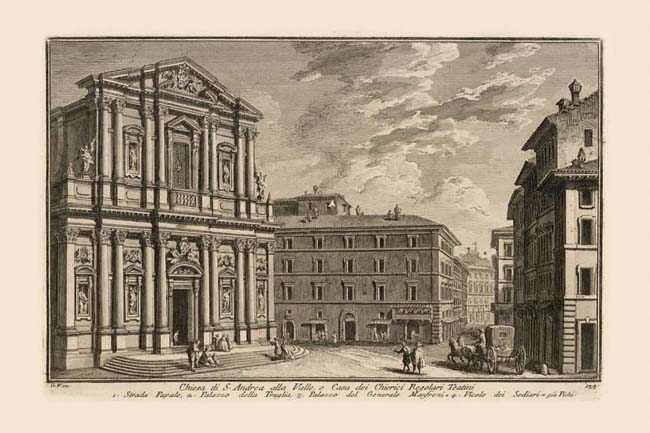
Chiesa di S. Andrea alla Valle, e Casa dei Chierici Regolari Teatini |
|
 |
|
 |
|
 |
|
| |
|
Chiesa di S. Andrea alla Valle, e Casa dei Chierici Regolari Teatini |
| |
1. |
Strada Papale |
| |
2. |
Palazzo della Truglia |
| |
3. |
Palazzo del Generale Manfroni già Pichi |
| |
4. |
Vicolo dei Sediari * già Pichi |
The story of S. Andrea della Valle is closely tied to that of the Via Papale (1) the processional route linking the Vatican to the Lateran. S. Sebastiano de Via Papae, a medieval church whose name clearly indicates the processional route, stood on this site, and was demolished by Sixtus V Peretti (1585-1590) to make way for the present church. The facade of the old church was aligned with the edge of the street shown in the 1551 Bufalini map. As the print indicates, the facade of the large new church was pulled back from the street so that it could be better seen by the processions moving toward the Lateran (Vasi includes angels on both sides of its upper façade even though only the left one was executed). This necessitated the occupation of the Piazza di Siena located behind the old church. Work on S. Andrea, which was modeled on the Chiesa del Gesù, Plate 135, was slow, starting in 1591 and carrying on until the 1660s when the facade was finished. The space between that facade and the right edge of the Via Papale became the determinant for the width of Corso Vittorio Emanuele II when it was cut through in the 1880s. This caused the demolition or partial demolition of all the buildings on the left of Via Papale, including Palazzo Trulli (2), and Palazzo Manfroni (3). More demolitions in the 1930s for the clearing of the new Piazza S. Andrea della Valle removed all the buildings in shadow on the extreme right, as far as Vicolo dei Sediari (4). This narrow street, in its widened form, became the Corso Rinascimento, which runs parallel to Piazza Navona.
|
