| |
135. |
|
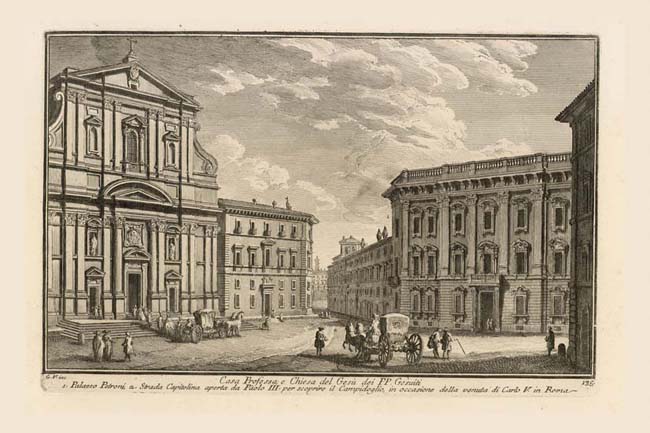
Casa Professa, e Chiesa del Gesù dei PP. Gesùiti |
|
 |
|
 |
|
 |
|
| |
|
Casa professa, e Chiesa del Gesù dei PP. Gesuiti |
| |
1. |
Palazzo Petroni |
| |
2. |
Strada Capitolina |
| |
2. |
Campidoglio |
This view of the Chiesa del Gesù is a companion to the contiguous view which features the adjacent Palazzo Altieri, Plate 79 (not visible in this print). Vasi's dual coverage of the Piazza del Gesù attests to its urban significance. This influential church, designed by Vignola and completed by Della Porta in 1582, was located at a critical point on the Via Papale, the processional route linking the Vatican to the Lateran. It was built over the site of an earlier church named S. Maria Alteriorum located on the old path of the papal processions on their way to Piazza S. Marco, Plate 115, (see also the 1551 Bufalini map). The new church blocked the old path and deflected these processions onto a new street leading directly to the Campidoglio, built under Paul III Farnese (1534-1549). That is the street we see in the print where Vasi has it lining up with the cordonata (stair-ramp) leading up to Piazza del Campidoglio, Plate 80, and centered on the Palazzo Senatorio with the bell tower rising above it. In reality this is not the case: the street axis is aligned with the corner of, and roughly parallel to, the colonnade at the base of the Palazzo dei Conservatori, so we may read Vasi's distortion as an attempt at urban clarity rather than cartographic precision. The Casa Professa attached to the Gesù was the residence of the Jesuits and encapsulates the apartments of S. Ignatius, founder of the order, which were in an older building on that site. On the right is the 16th century Palazzo Petroni/Bolognetti (1) with its new facade, built in 1737 by Fuga.
|
