|
| |
|
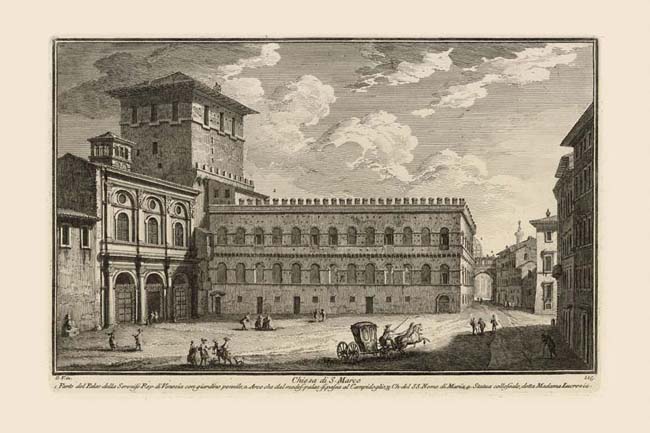
Chiesa di S. Marco |
| |
1. |
Parte del Palaz. della Serenissima Rep. di Venezia con giardino pensile |
| |
2. |
Arco che dal medesimo palaz. si passa al Campidoglio |
| |
3. |
Ch. del SS. Nome di Maria |
| |
4. |
Statua collossale detta Madama Lucrezia |
| |
|
Palazzo di Venezia |
| |
|
Piazza e Colonna Traiana |
Since St. Mark is the patron of Venice, it was only natural for the 9th century church of S. Marco to become the titular church of the Venetian Cardinal Pietro Barbo, who not only restored it, starting in 1455, but also began building a palace next to it at the same time. When Barbo was elected Pope (Paul II 1464-71), his nephew continued building the palazzo on a grander scale than was originally intended, until it completely surrounded the church, leaving only the facade that we see here visible on the exterior. The looming tower that appears in this print defines one end of the main facade of Palazzo Venezia (6) which faces the piazza of the same name Plates 39, 65. In 1465 the "Palazzetto Venezia (1)," which we see to the right of the tower, was added to the main block. Although Vasi refers to it as a hanging garden (giardino pensile) it was actually an enclosed garden courtyard as the Nolli map shows. Nolli also reveals that the little door in the left corner of the Palazzetto, next to the church, gave public access to a hall which led to the corner of Piazza Venezia, thereby providing a convenient short cut between the two diagonally opposed urban spaces. In the following century Pope Paul III Farnese (1534-1549) built an elevated walkway connecting the Palazzetto to the Capitoline hill, Plate 65, recalling the Passetto which connects the Vatican Palace to Castel S. Angelo, Plate 20. The arch (2) spanning the street is part of that walkway. In the distance, beyond the arch, can be seen the dome of the mid 18th century church of SS. Nome di Maria (3) facing onto Piazza della Colonna Traiana, named after Trajan's column which rises above the building to the right of the arch. Madama Lucrezia (4) on the far left is one of the city's four "talking" statues such as Pasquino locatd in the piazza of the same name, Plate 26A).
|


