| |
114. |
|
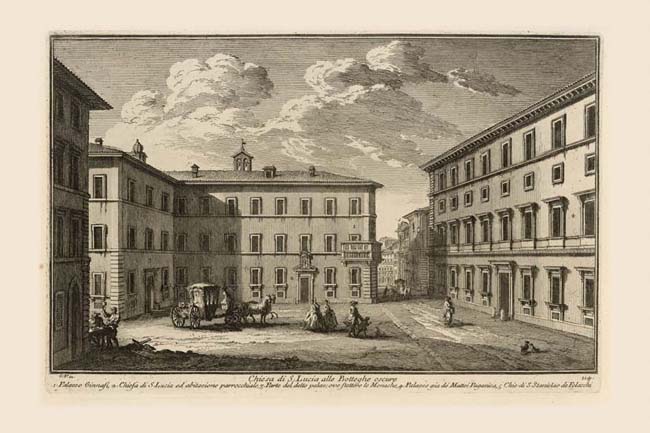
Chiesa di S. Lucia alle Botteghe oscure |
|
 |
|
 |
|
 |
|
| |
1. |
Palzzo Ginnasi |
| |
2. |
Chiesa di S. Lucia ed abitazione parrocchiale |
| |
3. |
Parte del detto palaz; ove stettero le Monache |
| |
4. |
Palazzo gia de Mattei Paganica |
| |
5. |
Chie. di S. Stanislao de Polacchi |
Nothing is left of the church of S. Lucia (2) today because the whole wing of Palazzo Ginnasi (1) facing us was demolished in the 1930s to widen the street we see on the right, known as "the street of the Dark Shops" (Botteghe Oscure) a condition which can be confirmed in the satellite image. The building attached to the left of this palazzo houses the associated nunnery (3). Nolli shows the street to be the border between Rione Pigna (on the left) and Rione S. Angelo. The church was unusual in that it lacked a true facade, being entirely encapsulated by Palazzo Ginnasi except for its front door. In this respect it resembles S. Lorenzo in Damaso enclosed within the Palazzo della Cancelleria, Plate 74. On the right is the facade of Palazzo Caetani (4), built by the Mattei family in the late 16th century. It was one of four Mattei palazzi, Plate 78, occupying the whole block which grew up on the site of the 1st century AD Theater of Balbus. The great rectangular court of that theater (Crypta Balbi) is occupied by the block beyond Palazzo Caetani on which we see the early 18th century facade of the church of S. Stanislao dei Polacchi (5), the Polish national church, which still functions as such to this day. Via delle Botteghe Oscure leads to the site of the next print in this series, Chiesa di S. Marco, Plate 115.
|
