| |
113. |
|
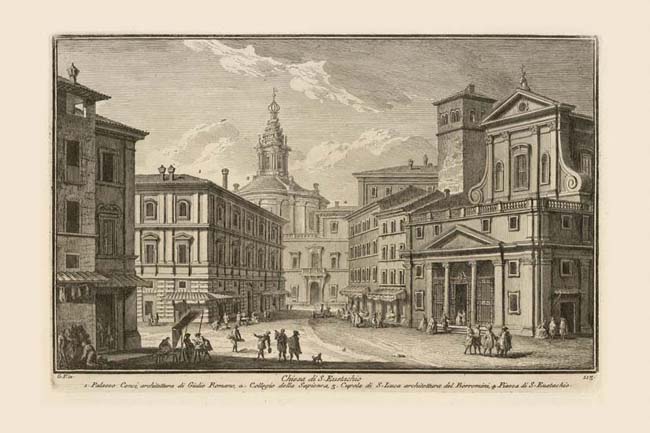
Chiesa di S. Eustachio |
|
 |
|
 |
|
 |
|
| |
|
Chiesa di S. Eustachio |
| |
1. |
Palazzo Cenci, architettura di Giulio Romano |
| |
2. |
Collegio della Sapienza |
| |
3. |
Cupola di S. Luca architettura del Borromini |
| |
4. |
Piazza di S. Eustachio |
Rare in this volume, ostensibly dedicated to churches, is the reference to a piazza. Vasi's mentioning Piazza S. Eustachio (4) by name suggests that this urban space had a particular importance or character. In fact three other smaller spaces radiate from the piazza. In this view, Piazza de' Caprettari (NN 791) opens off to the left, and Piazza Crescenzi, Plate 24A; NN 836, to the right. A third, nameless space along the right side of the Collegio della Sapienza is visible on the Nolli map, but not in the print. The 8th century church of S. Eustachio was rebuilt by the architects Corvara and Caneva between 1700 and 1724 (NN 802). On the left is the early 16th century Palazzo Cenci Maccarani (1) designed by Giulio Romano. The strategic location of this palace is obscured today by the late 19th century demolitions. Its main door terminated the Vicolo dell' Albergo de' Marchegiani which was a continuation of the Via di Ripetta. The Sapienza (2) Plate 161 (sapienza meaning knowledge) is the university building founded by Gregory XIII Boncompagni (1572-1585), continued under the succeeding Popes, and completed by Alexander VII Chigi (1655-1667). During the latter's reign Borromini completed one of his masterpieces: the church of S. Ivo (3) whose dome we see topped by the unusual spiral lantern (Vasi mislabels the cupola as the "Cupola di S. Luca"). Its concave facade faces onto a large courtyard, one of whose rear entrances we see framed by the end of the piazza. The building now houses the state archive and part of the offices of the Senate, Plate 70, which also took over Palazzo Cenci in the 1980s.
|
