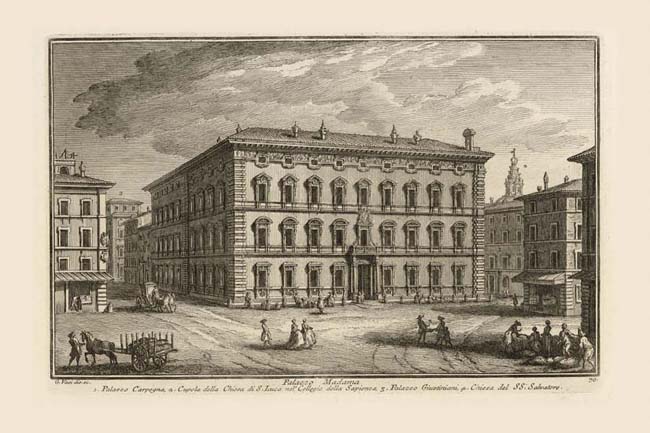
Nolli refers to the Palazzo Madama as "Palazzo Medici detto di Madama con ruine delle Terme Alessandrine" (Palazzo Medici known as Madama with ruins of the Baths of Alexander [Severus (222-235)]). The Florentine Medici made their presence felt in Rome when two members of the family became Pope in rapid succession: Leo X (1523-21) and Clement VII (1523-34). In 1537 a modest early 16th century palace was taken over by Madama Margherita of Austria, daughter of Charles V and widow of Alessandro de' Medici (hence the name Palazzo Madama). The Palazzo Madama in this print represents an early 17th century restoration and enlargement of the Medici palace by Il Cigoli and Maruscelli. Facing onto Piazza Madama (NN 805) and occupying the whole block, the complex included the (now demolished) church of S. Salvatore (4) on the side street from which a carriage is shown emerging. At the end of that street can be seen part of the late 16th century Palazzo Giustiniani (3). To the right of the Palazzo Madama we see Palazzo Carpegna (1) which in the 1930s was connected to the Medici building by means of a bridge spanning the (now closed) Via dei Staderari. Since 1871 Palazzo Madama has been the seat of the Italian Senate. The lantern visible behind Palazzo Carpegna belongs to Borromini's S. Ivo alla Sapienza (2) also shown in Plate 113, and not S. Luca as Vasi indicates.
|