| |
071. |
|
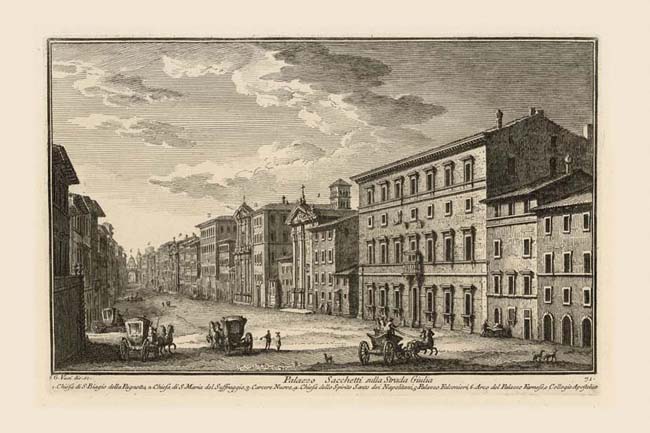
Palazzo Sacchetti sulla Strada Giulia |
|
 |
|
 |
|
 |
|
| |
|
Palazzo Sacchetti |
| |
|
Strada Giulia |
| |
1. |
Chiesa di S. Biagio della Pagnotta |
| |
2. |
Chiesa di S. Maria del Suffraggio |
| |
3. |
Carcere Nuove |
| |
4. |
Chiesa dello Spirito Santo dei Napolitani |
| |
5a. |
Palazzo Falconieri |
| |
5b. |
Palazzo Falconieri |
| |
6. |
Collegio Apostolico |
| |
6. |
Arco del Palazzo Farnese |
It is interesting to note that in spite of his entitling this volume of the Magnificenze "I Palazzi e le Vie" (palaces and streets),Vasi does not name any of its plates "Via" or "Strada" without preceding it with the name of a Palazzo, as in this case. The justification for this long view of Via Giulia is the Palazzo Sacchetti which dominates the right half of the print. Built by Sangallo (il Giovane) in the 1540s for his own use and acquired by the Sacchetti in 1648, this and Palazzo Falconieri (5) (see Plate 88) remodeled by Borromini in the mid 1600s are the only major palaces facing onto Via Giulia. When Julius II (1503-13) opened this street in the early part of his reign it was intended to replace the parallel Via Maior Arenula as the main street of the Rione Regola and to become a major expansion axis lined with important buildings, not least of which was to be the "Curia Julia" a large palace of justice, begun by Bramante but never completed. The only traces of this structure are large rusticated travertine blocks comprising a stone seat at street level, dubbed "i sofà di Via Giulia" by the locals. Vasi depicts two of these elements at the corners of the block containing the 1730s facade of S. Biagio della Pagnotta (1). More of these travertine blocks exist at the far corner of the next block, containing the mid 17th century church of S.M. del Suffragio (2), but Vasi does not show them. On the following block we see the Carceri Nuove (new prisons) (3) built at the time of Innocent X (1644-55). Further on the facade of S. Spirito dei Napolitani (4) is visible. In the distance Via Giulia is spanned by an arch (6) (see Plate 73) connecting palazzo Farnese to a dependency across the street, constituting the first leg of a bridge across the river to the Farnesina which was never completed. Vasi uses the same designation to denote the tower (6) at the end of the street belonging to the Collegio Apostolico.
|
