| |
088. |
|
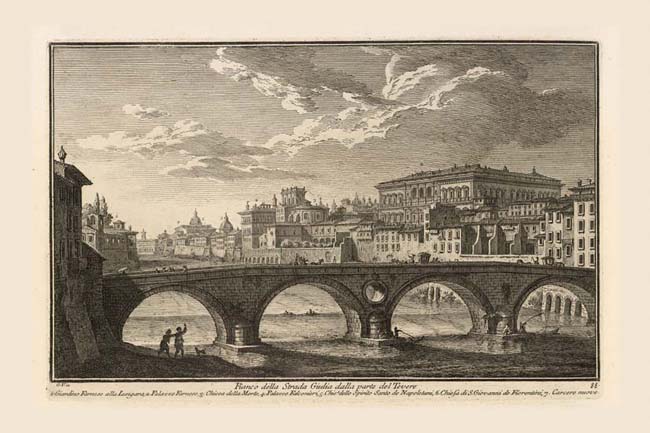
Fianco della Strada Giulia dalla parte del Tevere |
|
 |
|
 |
|
 |
|
| |
1. |
Giardino Farnese alla Lungara |
| |
2. |
Palazzo Farnese |
| |
3. |
Chiesa della Morte |
| |
4. |
Palazzo Falconieri |
| |
5. |
Chiesa dello Spirito Santo de Napoletani |
| |
6. |
Chiesa di S Giovanni de Fiorentini |
| |
7. |
Carcere Nuova |
| |
|
Ponte Sisto |
The Ponte Sisto was built by Sixtus IV Della Rovere (1471-1484) on the foundations of the ancient Pons Valentiniani which collapsed in the 6th century. In spite of their title of pontifex (bridge builder) this is the only bridge to be built by a Pope before the 19th century. This view looking upstream toward the Ponte Sisto is paired with another view taken from the opposite direction, Plate 89. The title derives from an earlier version of the print which did not have Ponte Sisto in the foreground (see Scalabroni 173bis). The name ("the side of Via Giulia towards the Tiber") refers to buildings between Via Giulia (Plate 71; NN 564) and the river, many of which were demolished to make way for the river walls in the late 19th century. Interestingly, Vasi presciently identified only the ones which have survived. These are from left to right, the dome of S. Giovanni dei Fiorentini (6) Plate 87; the Carcere Nuove (New Prison) (7) built under Innocent X Pamphilj (1644-1655); the Neapolitan church of the Holy Spirit (5); Palazzo Falconieri (4) with the Borromini three-bay altana (roof top belvedere); the oval Chiesa della Morte (3) designed by Fuga in 1733; and Palazzo Farnese (2) Plate 73. Unlike the previously mentioned structures, Palazzo Farnese is on the east side of Via Giulia. We see the sunlit rear facade of the palazzo from whose three-bay loggia one can see the Villa Farnesina (1) across the river (formerly the Villa Chigi) Plate 88A. The Farnese intended to connect their two properties with a bridge across the Tiber (never built).
|
