| |
087. |
|
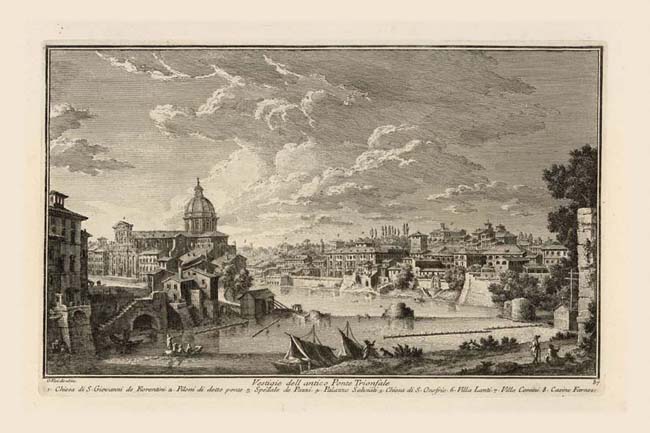
Vestigie del antico Ponte Trionfale |
|
 |
|
 |
|
 |
|
| |
1. |
Chiesa di S Giovanni de Fiorentini |
| |
2. |
Vestigie dell antico Ponte Trionfale |
| |
3. |
Spedale de Pazzi |
| |
4. |
Palazzo Salviati |
| |
5. |
Chiesa di S Onofrio |
| |
6. |
Villa Lanti |
| |
7. |
Villa Corsini |
| |
8. |
Casino Farnese |
The title of this print refers to the remains of the 1st century bridge (2) which still surfaces in the river at low water. Its three pylon stumps, together with the floating grain mill moored near the left-hand one, can also be seen on the Nolli map. Vasi depicts a set of sluices which channel the current toward the mill. The sinking boat near the left hand pylon suggests that the current was particularly strong at this bend in the Tiber. This view is particularly useful in illustrating connections which once existed between streets and river. For example the Via Giulia links to the river via the stair on the left and its neighboring ramp to the right leads down to the water and mulino (water mill). On the Trastevere side, to the right of the center pylon we see another ramp leading down to a fountain set within an arch, and another stair from the fountain to the river. Approaching the stair is a barchetta (cable ferry) (see Plate 87A) which also appears on the Nolli map (next to NN 1232) together with the ramp, fountain and stair. All of the riverside buildings on the left have disappeared except for the church of S. Giovanni dei Fiorentini (1), the national church of the Florentines facing onto the beginning of the Via Giulia, Plate 71. Sangallo designed the church in the early 16th century, but its dome was completed by Maderna in the early 1600s and its facade was not built until 1734 designed by Galilei. On the other side of the river the distant Casino Farnese (8) Plate 198A, on the Janiculum hill and the Villa Corsini (7) were both destroyed during the 1849 siege of Rome with reciprocal cannonades by Garibaldi from his headquarters in the former, and the French who occupied the latter. On the same hill, the early 16th century Villa Lante (6) survives today as the Finnish Academy. Below it we see the bulk of mid 16th century Palazzo Salviati (4) which faces onto Via della Lungara (see Plate 87A). Facing the river further to the right are the two courtyards of the Insane Asylum (3), demolished for the construction of the river walls. On the hill above, the church of S. Onofrio (5) Plate 123A, is at the head of a steeply sloping street whose course can be inferred from the buildings descending toward the right.
|
