| |
086. |
|
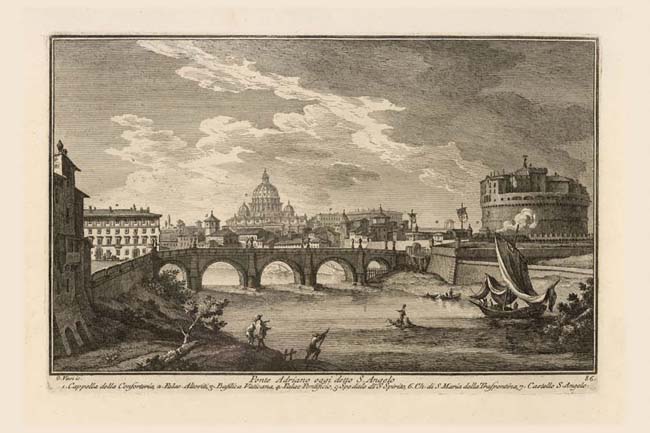
Ponte Adriano oggi detto S. Angelo |
|
 |
|
 |
|
 |
|
| |
|
Ponte Adriano oggi detto S Angelo |
| |
1. |
Cappella della Conforteria |
| |
2. |
Palazzo Altoviti |
| |
3. |
Basilica Vaticana |
| |
4. |
Palazzo Pontificio |
| |
5. |
Spedale di S Spirito |
| |
6. |
Chiesa di S Maria della Traspontina |
| |
7. |
Castello S Angelo |
This is one of the classic views of Rome repeated in numerous paintings, etchings and more recently in postcards: fishermen or boatmen in the foreground, Ponte and Castel S. Angelo (7) in the middle ground, and St. Peter's (3) in the distance with its dome rising above the center of the bridge, on which Bernini's angel statues stand out clearly. Except for Castel S. Angelo (7) and the distant Vatican buildings, most of what we see in this view has been demolished or has undergone radical transformation. The ancient bridge linking emperor Hadrian's tomb-turned-medieval-castle to the city was lengthened at both ends in the early 20th century to allow for the widening of the river and the building of the river walls. Building these walls meant the demolition of all the buildings on the left and of the castle's riverside bastion on the right. With the widening of the river, the Conforteria (1), seen more clearly in another Vasi view, Plate 85A, disappeared along with the part of Piazza di Ponte depicted here and the Renaissance Palazzo Altoviti (2), which, at the time of its destruction, had been degraded to a fabbrica di birra (beer factory). On the other shore, Vasi depicts the old Borgo quarter (visible just above the bridge), most of which was demolished under Mussolini in the 1930s, except for the Hospital of S. Spirito (5) Plate 171, the church of S. Maria Traspontina (6) Plate 124 and a few other buildings not discernible in this view. St. Peter's (3) Plates 41, 41A, looms in the background, flanked on the right by the Vatican palaces (4) and Bramante's Belvedere courtyard whose far end, Plate 181, Nicchione (great niche) is visible between the two banners of Castel S. Angelo. Atop the castle the statue of the archangel Michael stands on the medieval tower which rises slightly above the buildings constituting a papal palace built in the 16th century. In 1765, four years after completing the ten-volume Magnificenze, Vasi published an enlarged version of this image taken from a more elevated viewpoint.
|
