| |
124. |
|
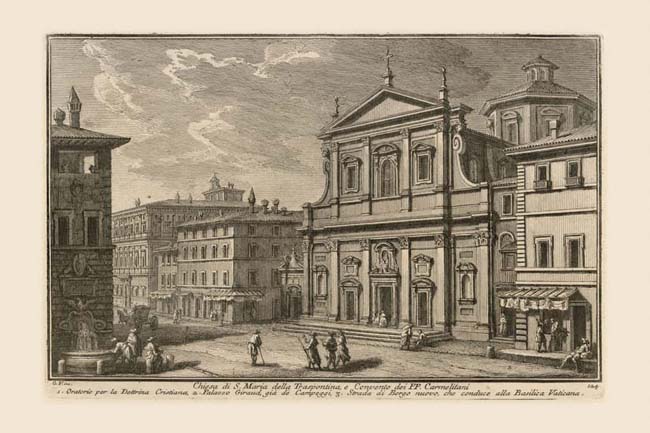
Chiesa di S. Maria della Traspontina, e Convento dei PP. Carmelitani. |
|
 |
|
 |
|
 |
|
| |
|
Chiesa di S. Maria della Traspontina, e Convento dei PP. Carmelitani. |
| |
1. |
Oratorio per la Dottrina Cristiana |
| |
2. |
Palazzo Giraud già dei Campeggi |
| |
3. |
Strada di Borgo Nuovo che conduce alla Basilica Vaticana
|
S. Maria della Traspontina substituted for an earlier church which stood on the piazza next to Castel S. Angelo (as shown by the 1551 Bufalini map). Traspontina means "across the bridge" referring to Ponte S. Angelo. The early church was demolished to make way for one of the pentagonal bastions added to the castle at the time of Pius IV Medici (1559-1565). The new church was begun in 1566 by Sallustio Peruzzi, but completed only seventy years later. It faced onto Borgo Nuovo (3) Rome's first Renaissance straight street built for the Jubilee year of 1500 under Alexander VI Borgia (1492-1503). Borgo Nuovo replaced the parallel Borgo Vecchio as the first leg of the papal processional route from the Vatican to the Lateran. In his caption Vasi says that Borgo Nuovo "leads to the Vatican Basilica," which is not quite true because it did so only indirectly since its axis was designed to lead to the Porta Palatina, (the major Vatican Palace portal). Also facing onto Borgo Nuovo is the Oratorio della Dottrina Christiana (1) built in 1715, and the late 15th century Palazzo Giraud (2). In a nearby view, just to the west of S. Giacomo in Scossacavalli, Plate 120, Vasi reveals both this palace and S. Maria della Traspontina from another vantage point.
|
