|
| |
1. |
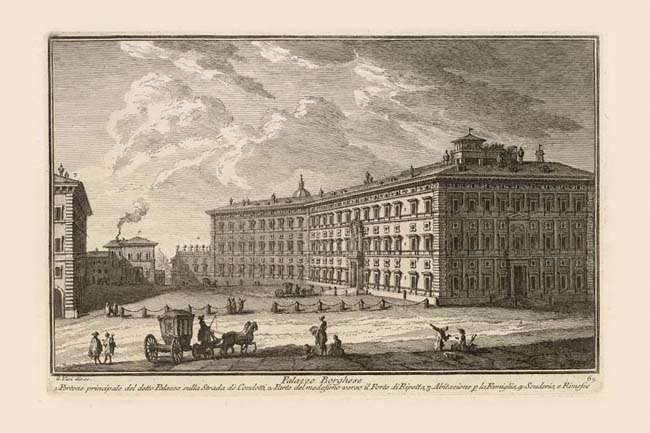
Palazzo Borghese |
| |
2. |
Parte del medesimo verso il Porto di Ripetta |
| |
3. |
Abitzaione per la Famiglia |
| |
4. |
Scuderia, e Rimesse |
| |
-. |
Piazza Borghese |
As Vasi points out, all the buildings surrounding the piazza belonged to the Borghese, forming a sort of family enclave completed by the row of bollards and chains separating it from the Via Trinitatis (now known as Via della Fontanella di Borghese). The latter was built as the cross-axis of the Popolo trivium by Paul III (1534-49). Cardinal Deza initiated what was to become the Palazzo Borghese (1) in the late 16th century by building along this street. The Borghese acquired the unfinished palace in 1604 and extended it so as to connect with, and encompass Palazzo del Giglio, the part beyond the bend in the lateral facade. Simultaneously two small blocks of houses were demolished in order to clear space for the piazza, where a new door was built in the long facade. The last addition to the main building was the pavilion-like extension (2) toward Via Ripetta built by Ponzio in 1612. Between this wing and the Borghese stables (4) Vasi depicts an impossible view of the dome of St. Peter's. At the extreme left we see the "abitazione per la Famiglia" (3) which was the residence for the retinue of artisans and servants attached to the Borghese family.
|


