| |
068. |
|
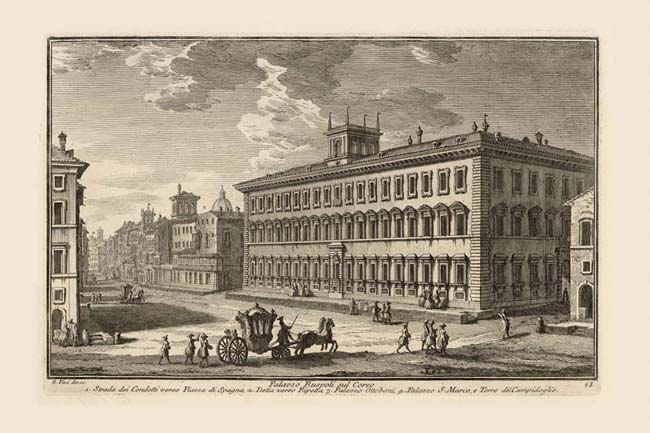
Palazzo Ruspoli sul Corso |
|
 |
|
 |
|
 |
|
| |
|
Palazzo Ruspoli sul Corso |
| |
1. |
Strada dei Condotti verso Piazza di Spagna |
| |
2. |
Detta verso Ripetta |
| |
3. |
Palazzo Ottoboni |
| |
4. |
Toree del Campidoglio |
| |
4. |
Palazzo S. Marco, e Torre del Campidolgio |
This long perspective view of Via del Corso is a companion to Plate 67 of Palazzo Colonna di Sciarra which shows the same street, but looking in the opposite direction. The scene terminates in the distance with Piazza Venezia and the towers of Paul III and the Campidoglio (4) (see Plate 65). The Via dei Condotti (1) in the left foreground and its continuation across the Corso (2) now known as Via della Fontanella di Borghese, form part of the Renaissance Via Trinitatis. Paul III (1534-49) had the street cut through to join Piazza Nicosia, Plate 167, to Piazza di Spagna, Plates 40, 40A, and constituted the main cross-axis to the Popolo trivium. One can see the corner of the Trinitarian convent to the left of the print which also appears in the contiguous view, Plate 128, showing the Via dei Condotti continuing toward the Pincian Hill and terminated by SS. Trinita dei Monti in the distance. The history of the Palazzo Ruspoli begins in 1556, not long after the opening of Via Trinitatis, when Ammanati designed the Palazzo Rucellai at this intersection with Via del Corso. The palazzo passed to the Caetani in 1629, and to the Ruspoli in 1776. Its main door, just visible in the street leading to the right is on the Via Trinitatis, indicating the greater importance of this street with respect to the Corso, which at that time was only the edge of the built-up city. In the 19th century, by which time the city had expanded well beyond the Corso, the ornamental central window on the Corso facade was turned into a door, but the main door, leading to the courtyard and stairs, remained the original one. The opening in the wall of the street beyond the palazzo is Piazza S. Lorenzo in Lucina, Plate 105, bordered on the south side by Palazzo Ottoboni (3) largely reconstructed in the 19th century. Above it extends an impossible view of the distant dome of S. Agnese in Piazza Navona.
|
