| |
105. |
|
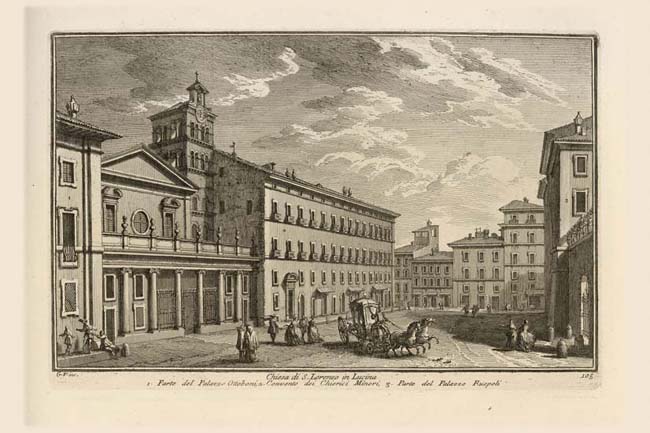
Chiesa di S. Lorenzo in Lucina |
|
 |
|
 |
|
 |
|
| |
|
Chiesa di S. Lorenzo in Lucina |
| |
1. |
Parte del Palazzo Ottoboni |
| |
2. |
Convento dei Chierici Minori |
| |
3. |
Parte del Palazzo Ruspoli |
The entrance from Via del Corso to this piazza appears in another Vasi print, Plate 68, between two large palazzi which also appear in this view. The long sides of this trapezoidal piazza seem to converge toward the end buildings, whereas in fact they converge in the opposite direction toward the viewer. On the left we see one bay of Palazzo Ottoboni/Fiano (1), under whose opposite corner the remains of the ancient Ara Pacis were excavated in the 1930s. The gateway on the far right once led into the garden of Palazzo Ruspoli (3) begun by the Florentine Rucellai family in the late 16th century and shown by Vasi in another print, Plate 68. As Nolli reveals, its main door, on axis with this gate, opens onto the Via della Fontanella Borghese (Via Trinitatis on the 1551 Bufalini map), which is the main cross-street of the Piazza del Popolo trivium. The early Christian church of S. Lorenzo in Lucina was rebuilt in the 12th century and restored in the mid 17th century, at which time the large monastery (2) adjoining it to the right was constructed. The remains of the great sundial built at the time of Emperor Augustus (27 BC – 14 AD) were recently discovered by archeologists under the church. Vasi shows its gnomon in two prints. First being excavated in 1748, Plate 21B, and later erected as it now stands in Piazza Montecitorio, Plate 23. Nolli reveals the precise position of the prone obelisk in his map as a splinter-like element immediately to the right of NN 344.
|
