| |
065. |
|
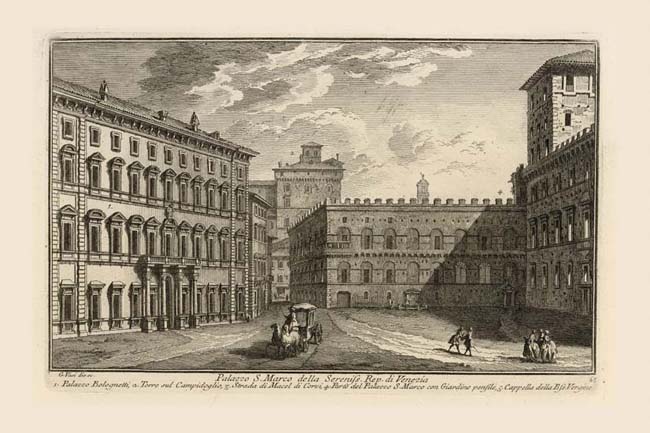
Palazzo S. Marco della Sereniss. Rep. di Venezia |
|
 |
|
 |
|
 |
|
| |
1. |
Palazzo Bolognetti |
| |
2. |
Torre sul Campidoglio |
| |
3. |
Strada di Macel di Corvi |
| |
4. |
Palazzo S Marco con Giardino pensile |
| |
5. |
Cappella della B SS Verguine |
Except for the Palazzo Venezia and the distant bell tower of the Campidoglio, every building in this view was demolished or moved elsewhere in the late 19th and early 20th centuries, in order to make way for the great white monument dedicated to Victor Emanuel II. The relatively small, defined area of Piazza Venezia, which this print shows so clearly, then became a vast, undefined, amorphous space. Palazzo Venezia was started in 1455 by the Venetian Cardinal Pietro Barbo, as a residence built around the Venetian national church of S. Marco, Plate 115 (thus the dual naming of the palace). It was completed by his nephew after Pietro was elected Pope Paul II (1464-71). The building became the Venetian embassy after 1564. Vasi shows a small chapel and doorway (5) leading to the passage between this piazza the piazza associated with the church. The crenellated building at the center of this view is often referred to as the "Palazzetto Venezia" (4) but was really a courtyard/garden added to the corner of the main building in the 1460s. Paul III (1534-49) connected the palazzetto (small palace) to the Campidoglio by means of an elevated passageway spanning two streets, one is the Strada di Macel dei Corvi (3) and leading to the tower (2) which he had built on that hill, next to the monastery of Ara Coeli. The Nolli map shows this passage as two parallel lines terminating in a winding cordonata (stair-ramp) leading up to the square tower. The palazzetto was demolished and rebuilt (very approximately) at the southwest corner of Palazzo Venezia in 1911. The Baroque Palazzo Bolognetti (1) was demolished in 1900 together with Palazzo Parracciani (NN 276) beyond it. The annual race of the riderless wild horses (barberi) involved a course down the Via del Corso (in Vasi's day it was simply the "Corso" – the only one in town) terminating at the short street between the Palazzo Parracciani and the Palazzetto Venezia, known as the Ripresa dei Barbari (NN 111). This name derives from the practice of hanging a large sheet across the street at this point to stop the horses. Vasi shows two additional plates which extend this view. In the contiguous print, Plate 39, he completes the Palazzo Venezia by swinging his gaze clockwise to the west and in the next continuing this sequence, Plate 170, he directs the viewer's attention north along the Corso to Piazza del Popolo in the distance.
|
