|
| |
|
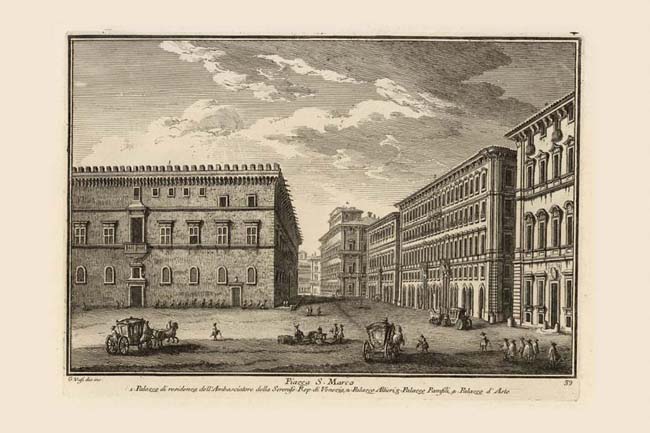
Piazza S. Marco |
| |
1. |
Palazzo di Venezia |
| |
2. |
Palazzo Altieri |
| |
3. |
Palazzo Pamfili |
| |
4. |
Palazzo d'Aste |
| |
5. |
Palazzo Gottifredi |
This print might better have been entitled "Via del Gesù", the street alongside Palazzo Venezia (left), and shown disappearing into the distance. The street was renamed Via del Plebiscito in the late 19th century to commemorate the 1871 plebiscite on the unification of Italy. Only part of the square which Vasi calls "Piazza S. Marco" and Nolli names "Piazza di Venezia" (NN 906) is visible in this print. The rest of it and of the palazzo Venezia can be seen in a companion print, Plate 66. Palazzo Venezia (1) was started in 1455 by Cardinal Pietro, as a residence built around the Venetian national church of S. Marco. It was completed by his nephew after Pietro was elected Pope Paul II. The building became the Venetian embassy after 1564. The balcony of the piano nobile was made famous by Mussolini who used it to address the crowds during the Fascist period. Vasi seems particularly interested in the row of palaces lining Via del Gesù on the right. The mid-17th century Palazzo d'Aste (4) in the right foreground appears again in another print showing its position at the beginning of Via del Corso, Plate 170. Next in line is the enormous Palazzo Pamphilj (3) which has two other major facades, one on Piazza del Collegio Romano, Plate 66, and the other on Via del Corso, Plate 44. This one is the latest of the three facades, built in the 1740s by the Roman architect Paolo Ameli. Vasi does not number the next palazzo named Gottifredi (NN 857). It was built in the 17th century and completely remodeled in the mid 19th century by the Grazioli family who still own it. The Via del Gesù narrows where the corner of Palazzo Altieri (2) protrudes into it. A better view of this 17th century palace appears in another Vasi print, Plate 79.
|


