| |
170. |
|
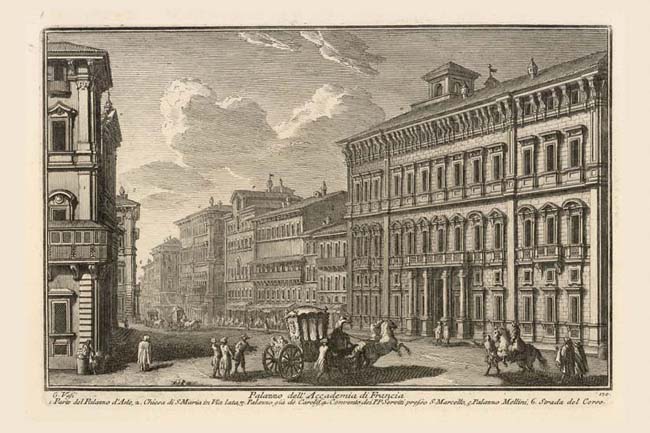
Palazzo dell'Accademia di Francia |
|
 |
|
 |
|
 |
|
| |
|
Palazzo dell'Accademia di Francia |
| |
1. |
Parte del Palazzo d'Aste |
| |
2. |
Chiesa di S. Maria in Via Lata |
| |
3. |
Palazzo già de Carolis |
| |
4. |
Convento dei PP Serviti presso S. Marcello |
| |
5. |
Pal. Mellini |
| |
6. |
Strada del Corso |
This view of Via del Corso from Piazza Venezia has the opposing sides of the street drawn out of phase. In reality the Palazzo dell'Accademia di Francia (formerly the Palazzo Mancini) at the center of the print is located a whole city block further away from the Palazzo d'Aste (1) shown on the left occupying the edge of Piazza Venezia, Plate 39. In the early 19th century Palazzo d'Aste belonged to Napoleon's mother, who, unobserved behind the grills of the corner balcony, used to watch the activity along the Corso and in Piazza Venezia on feast days such as Carnival. Next to Palazzo d'Aste, Palazzo Doria-Pamphilj appears to be telescoped into the corner church of S. Maria in Via Lata (2), featured in Plate 44. Beyond the church juts the corner of the early 18th century Palazzo De Carolis (3) also seen in Plate 39. On the opposite side the academy building is a late 17th century design by Carlo Rainaldi. In 1803 the French Academy moved to Villa Medici, shown in Plate 188, on the Pincian hill. To the left of this palazzo Vasi depicts a range of buildings including the monastery of S. Marcello (4) and the mid-18th century Palazzo Mellini (5) without leaving much room between for the setback in front of the church of S. Marcello (Plate 138 shows both the church and monastery in detail). A related view taken in the opposing direction, Plate 133, highlights these structures including the church and its relationship to the Corso.
|
