| |
133. |
|
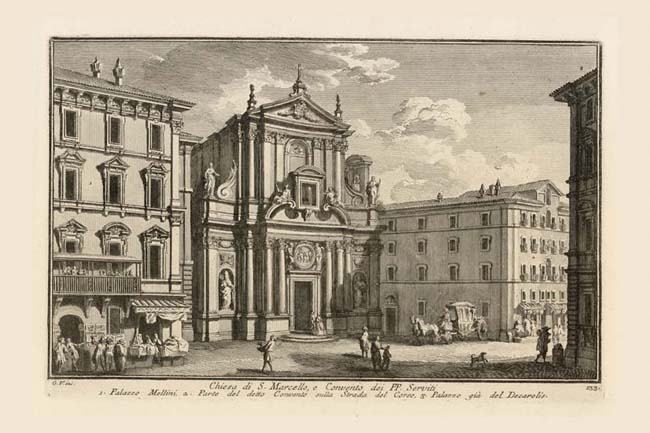
Chiesa di S. Marcello, e Convento dei PP. Serviti |
|
 |
|
 |
|
 |
|
| |
|
Chiesa di S. Marcello, e Convento dei PP. Serviti |
| |
1. |
Palazzo Mellini |
| |
2. |
Parte del detto Convento sulla Strada del Corso |
| |
3. |
Palazzo già Decarolis |
One of the city's earliest churches, S. Marcello originally faced east, away from the Via del Corso and onto a small piazza. When the church was rebuilt in the early 16th century, it was turned to face the Corso, then known as Via Lata, which by then had become a major street in the developing city. The importance of this church is attested by the list of famous architects associated with its transformation: Sansovino and Antonio da Sangallo the Younger in the 1500s, culminating in the late 1600s with Carlo Fontana who is responsible for the facade, which is set back from the street in its own small piazza. This space is flanked on the right by the monastery (2) attached to the church, and on the left by the mid 17th century Palazzo Mellini (1). As an interesting autobiographical aside, Vasi shows a group of figures admiring prints displayed outside a shop at the palace's entrance. One of Vasi's publishers, Chracas Printers of San Marco al Corso, was located in the Via del Corso and near S. Marcello. The 18th century Palazzo de Carolis (3) whose corner is in shadow on the right, is now headquarters of the Banca di Roma. Vasi also shows this section of the Corso from a second vantage point farther down the Corso, Plate 170.
|
