| |
146. |
|
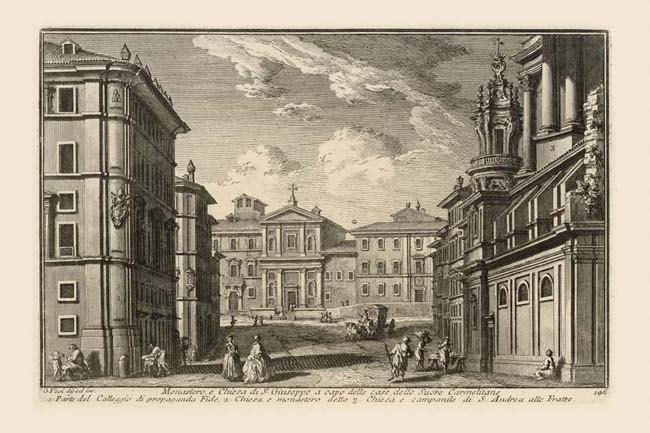
Monastero, e Chiesa di S. Giuseppe a capo delle case delle Suore Carmelitane |
|
 |
|
 |
|
 |
|
| |
1. |
Parte del Colleggio di Propaganda Fide |
| |
2. |
Chiesa e monastero detto |
| |
3. |
Chiesa e campanile di S. Andrea delle Fratte |
This view of Via Capo le Case is taken at its intersection with Via di Propaganda and serves as one of two contiguous views by Vasi, the other devoted entirely to the Collegio di Propaganda Fide (1) Plate 164A, seen on the left. In order to show both the plain, early 17th century church of St. Joseph and the convent (2) to its right, Vasi widened the narrow Via Capo le Case into the dimensions of a minor piazza. Two parallel lines drawn sketchily on the ground suggest the real width of the sloping street. The name Capo le case translates roughly as "where the houses end," meaning that this was the edge of the town at the time. Vasi's widening distortion causes further telescopic distortion on the right side of the street where we see the flank of S. Andrea delle Fratte (3). The tower-like dome (top right) and complex bell tower immediately to its left are Borromini's 1665 additions to the church. They are drawn in sharply contrasting detail, suggesting Vasi's admiration for the work of that imaginative Baroque architect. Of note is the rough unfinished upper portion of the front facade of the church, not completed until the 19th century. At the left edge of the print is the corner of the headquarters of the Congregation for the Propagation of the Faith (1) begun by Borromini in 1646, but not finished until long after his death. An unusual error of detail appears on the rounded corner at the top level of this building: Vasi substitutes the 6 hills of the Chigi coat-of-arms for the 3 hills of the Albani arms actually present. The latter date the completion of the building to the early 18th century.
|
