| |
189. |
|
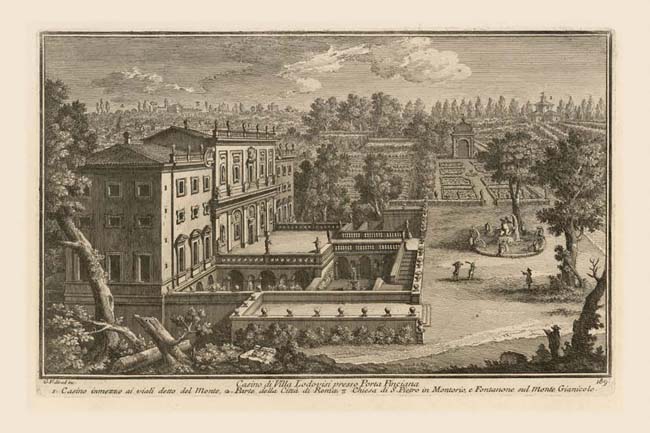
Casino di Villa Ludovisi presso Porta Pinciana |
|
 |
|
 |
|
 |
|
| |
|
Casino di Villa Ludovisi presso Porta Pinciana |
| |
1. |
Casino inmezzo ai viali detto del Monte |
| |
3. |
Chiesa di S. Pietro in Montorio, e Fontanone sul Monte Gianicolo |
This is one of Vasi's rare bird's eye views which allows for a paroramic view of the villa and the city in the distant background. In his index, Nolli refers to this as Palazzo e Villa Ludovisi, which implies a combination of town house and villa. The Ludovisi combined palazzo and villa by acquiring contiguous properties in the early 1620s: first the 16th century Casino del Monte (1) and adjacent area from that family, then the palace (in the foreground) from the Orsini family. As a type, it resembles the nearby Palazzo Barberini, Plate 36: both combined a palace and villa; both were on edge of the city and took advantage of the slope of a hill to provide terrace entrances from gardens on the piano nobile level. The villa's location on the edge of the built up city is indicated by the name of a nearby street: Via di Capo le Case ("the street where the houses end," now part of Via Francesco Crispi). The villa was just inside the city walls, which formed one of its boundaries. Another boundary, not shown by Vasi, was a street along the side facade of the palazzo, whose earlier presence caused the corner of the building to be an acute angle (and not the apparent right angle shown here which can be confirmed in the Nolli map). In the 1880s the Boncompagni-Ludovisi sold off the villa grounds (now the Via Veneto neighborhood), but kept the palazzo which became the leg of a large T-shaped building, since 1931 the U.S. embassy to Italy. In the distance on the left, what Vasi identifies as "part of the city of Rome" (2) corresponds to Campo Marzio. On the horizon we see S. Pietro in Montorio and the Acqua Paola on the Janiculum hill (3) both of which appear in another Vasi print as distant elements, Plate 99.
|
