|
Field
Guide IDs: BREEDING:
Marshes, lakes. 1
brood. DISPLAYS:
Elaborate mutual
displays performed by 2 or more birds in
predictable sequences: "rushing" by 2 males, male
and female, or several males and a female; "weed
dance" with male and female holding plants in
bills; "greeting" by pairs rejoining after
separation. NEST:
Floating platform
in shallow water; compact mass of fresh and decayed
veg, oft coated with aquatic veg, usu anchored to
or built up over live veg. Open or
concealed. EGGS:
Bluish-white,
chalky, nest-stained buff/brown. 2.3" (58
mm). DIET:
Mostly fish,
aquatic inverts, few amphibians, feathers. Young
fed adults' feathers. CONSERVATION:
Winters s to c
Mexico. Blue List 1973-82, Special Concern 1986.
Plume hunters devastated populations. NOTES:
Colonies of tens to
hundreds of nests; gregarious year-round. Recently
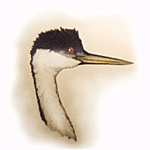
split into two species Western and Clark's; Western
is the dark-faced form); double-noted advertising
call prevents hybridization. Tend to feed nearer to
shore than Clark's Grebe, suggesting possibility of
reduced foraging overlap Bare skin patch on head of
young flushes dark red when begging or in distress.
Chicks carried on adults' backs; young fed while
carried. STANFORD.
NOTES: ESSAYS: Eating
Feathers;
Visual
Displays;
Transporting
Young;
Plume
Trade;
Species
and Speciation;
Blue
List. REFERENCES:
Nuechterlein,
1981a, 1985; Nuechterlein and Storer,
1982.. |