Development
Development of the Inca Empire:
The Great Reorganization
I. Hunting and Gathering -> Chiefdom
Back to
Development Front PagePrevious Page: Great Transformation | Next Page: Maintenance
I. Hunting and Gathering
à ChiefdomWhat?
Hunting and Gathering -> Chiefdom -> StateWhen? circa 8,000 B.C.- A.D. 1400 (in the Peruvian context)
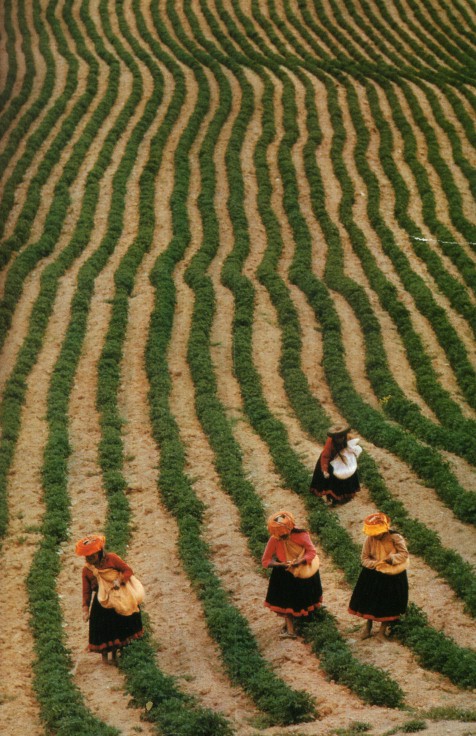
To compensate for cultivation's inherent instability, agriculturists must overproduce to ensure that they are left with enough food after a potential drought, flood, or invasion of pests. This overproduction leads to the new possiblity of SURPLUS.
Surplus requires some form of STORAGE and leads to an unequal distribution of resources. Personal PROPERTY emerges and results both in TRADE and a SOCIAL HIERARCHY. An abundance of resources frees some people from having to perform agricultural labor and gives rise to new social roles. Examples of these new SPECIALIZATIONS include artisanship, administration, and the military.
With agriculture comes many questions: How many crops should be planted? Where is the best place to put them? When should they be planted? When should they be harvested? How should the surplus be distributed? How should technology such as irrigation systems be managed?
With so many variables and uncertainties, a stable organizing entity is essential to agricultural success. This LEADERSHIP position took different forms as the Great Reorganization progressed in South America.
Chiefs were the first strong political leaders. They were "information specialists" in that they stored and gathered information in order to control, manage, and make decisions for the good of the people. Chiefs decided when, where, and which crops should be planted, organized the agricultural technology, and distributed the surplus food. They maintained their power and authority by CONVINCING people of the wisdom and benefits of their plans.
The CHAVIN culture of the Northern Peruvian highlands is an excellent example of an early CHIEFDOM. Chavin implemented the method of CONVINCING. Chavin chiefs went to extremes to convince people of their power. Intricate carvings of half-human, half-animal forms in temples served to terrify people and neighboring chiefs. This strong convincing power resulted in donations from other tribes that helped support Chavin, which was built in a valley with very low productivity.
Top of PageII. Chiefdom
à StateAs societies in the Peruvian region grew more complex, the convincing power of the chief gradually became more coercive and eventually evolved into the socio-political organization of a STATE. A state is on a larger scale than a chiefdom and has a more rigid social stratification. Because maintenance is based on COERCION, a full-time military must be present to enforce the state's power in addition to defending the state from outside invaders.
MOCHE was considered the first real state in Peru and was a precursor to the more highly developed Incan state. Rulers were portrayed in art as strong, capable and coercive individuals. State power was displayed in the monumental architecture. The irrigation system was controlled by the state. increasing rewards for leadership were demonstrated in the extravagant burial sites of the rulers.
Appendix for a summary of prehistoric Peruvian societies.III. The Incan State
The Incan Empire began in the 12th century with the founding of Cuzco by Manco Capac, the first Inca. For the following few hundred years, the Incas controlled only a small area around Cuzco. Their great expansion did not start until 1438 when Pachacutec became the ninth Inca. He started by defeating the neighboring Chanka tribe, and then conquered most of the central Andes over the next 25 years. Pachacutec was an excellent urban planner and had Cuzco reconstructed in the shape of a puma, as the empire's symbol. Northwest of Cuzco, he also began building what became South America's most famous archaeological site: Machu Picchu. The Incan Empire continued to grow under the rule of Pachacutec's son, Tupac Yupanqui. By 1493, the Incas controlled an area extending from Quito in Ecuador to south of Santiago in Chile.
Of the 10 million people in the Empire, only 40,000 were ethnic Incans. The rest were considered "subjects." Political tension existed between the various Andean tribes and ethnic groups. Taking advantage of these conflicts, the Incas easily conquered them all. However, with so much land and so many different peoples, consolidating the Empire was difficult. The Incas maintained the Empire's strength and cohesion by making each newly conquered group feel like an important part of the whole. An ethnically Incan woman often married the conquered leader or his son, thereby making the next generation of local rulers loyal to the Incan Empire. Other effective means of consolidation were improving communication systems and imposing a common language, Runa Simi. The vast 23,000 kilometer network of highways allowed for widespread travel, trade, and communication. Agriculture also played a key role in the remarkable expansion of the Incan empire. Irrigation canals allowed for the exploitation and colonization of arid regions, which helped feed the Growing population.
Previous Page: Great Transformation | Next Page: Maintenance
Back to
Development Front Page