Data Sanitization to Reduce Private Information Leakage from Functional Genomics
Abstract
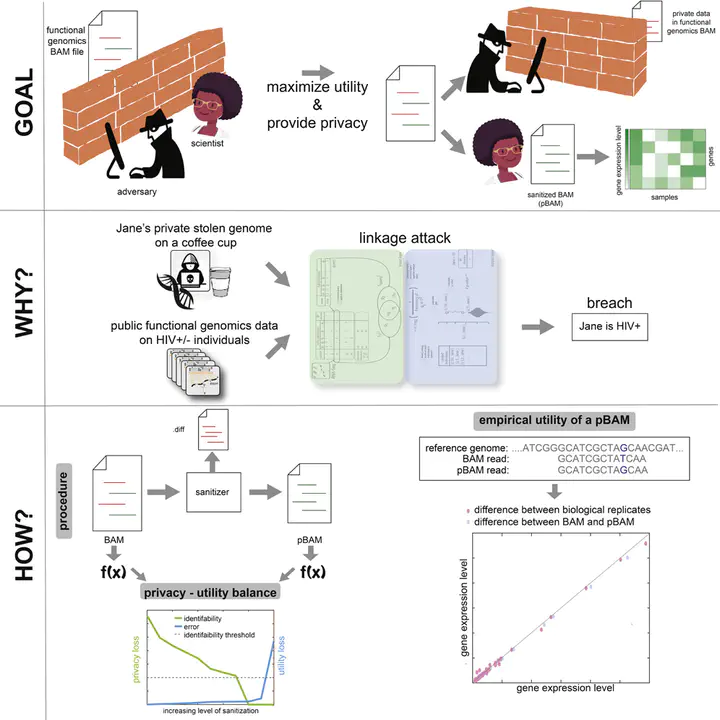
The generation of functional genomics datasets is surging, because they provide insight into gene regulation and organismal phenotypes (e.g., genes upregulated in cancer). The intent behind functional genomics experiments is not necessarily to study genetic variants, yet they pose privacy concerns due to their use of next-generation sequencing. Moreover, there is a great incentive to broadly share raw reads for better statistical power and general research reproducibility. Thus, we need new modes of sharing beyond traditional controlled-access models. Here, we develop a data-sanitization procedure allowing raw functional genomics reads to be shared while minimizing privacy leakage, enabling principled privacy-utility trade-offs. Our protocol works with traditional Illumina-based assays and newer technologies such as 10x single-cell RNA sequencing. It involves quantifying the privacy leakage in reads by statistically linking study participants to known individuals. We carried out these linkages using data from highly accurate reference genomes and more realistic environmental samples.

Charlotte Brannon
PhD Student
My research interests include biomineralization, collective cell behavior, and computational genomics.