
COMMUNITY RHETORICS:
Writing from the Inside
Syllabus
COMMUNITY RHETORICS: Writing from the Inside
Required Texts and Reading Assignments / Required Writing / Reading Presentations / Portfolios
Presentation of Written Work / Conferences, Peer Review, and Revisions
Late Work / Attendance and Late Policy / Plagiarism
Grading / Grade Disputes
GOALS OF THE PROGRAM IN WRITING AND RHETORIC
The goals of PWR are simple to state: we aim to guide Stanford's students in writing academic arguments and research-based essays, using rhetorical principles that will enable them to enter courses in many fields, analyze the discourses they find there, and, on the basis of their analyses, begin to participate effectively in those discourses, whether oral or written. Find PWR's web site at http://pwr.stanford.edu .
How many discourse communities do you belong to? Understanding discourse communities and the rhetoric--the language and communication styles --particular to each equates to understanding audience and purpose in writing. Discourse communities vary widely not only with age, culture, ethnicity, language, and nationality (among other factors), but also with experience, education, academic discipline, and professional expertise. Members of each discourse community have common interests and concerns, and in expressing or sharing these interests they practice a community rhetoric unique to the community's goals. In this course, we will explore ways of "knowing," methods of research, and forms and styles of written, oral, and visual communication from inside diverse discourse communities.
This class will encourage you to
€ understand and practice the process behind the "finished" written product;
€ consider interdisciplinary approaches to thinking, writing, and research;
€ read and write, listen and speak with attention to audience and purpose and with sensitivity to nuances of argument;
€ explore strategies of research, analysis, organization, and argumentation and apply them to your writing;
€ develop a comfortable and confident prose style as well as a presence in oral delivery, each well suited to varieties of audiences and purposes;
€ collaborate with other students as well as with community members in research, writing, and revision;
€ understand that knowledge in general and writing in particular (including student writing) are real, having value and consequences.
Required Texts and Reading Assignments
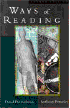
Bartholomae, David, and Anthony Petrosky. Ways of Reading: An Anthology for Writers. Bedford/St. Martin's, 2002.
Diana Hacker. A Pocket Manual of Style. St, Martin's Press, 2000. 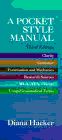

Andrew Harnack and Eugene Kleppinger. Online!: A Reference Guide to Using Internet Sources. St. Martin's, 2000. Please complete readings by the dates assigned -- the quality of your written work and of class discussions will depend upon your doing so.
The majority of assigned readings for this course will be found in Ways of Reading.
Hacker's Pocket Style Manual and Harnack and Kleppinger's Online! will serve as helpful reference sources, guiding you through research, evaluation, and documentation of outside sources.
Back to Top
In your writing assignments this quarter, I mean to challenge you creatively, critically, and practically. In selecting and developing the assignments I have, I of course have in mind certain learning objectives. One of the most important of these objectives is that you should discover and explore your own interests, within our very broad course theme. In all assignments, determining your own topic is a crucial step in the writing process.
1. Project #1. The Leap-of-Faith Essay: A Contextual Analysis. This essay will provide practice in blending personal and analytical writing, drawing upon visual and written texts. Length of finished essay: 5-6 pages; part #1 due 10/3; part #2 due 10/3; complete draft due 10/18, revision due 10/25.
2. Project #2. The Audio Essay: Rhetorical Analysis/Rhetorical Practice. This project is an experiment in audio rhetoric. You will be asked to work with a collaborative group to research, write, and produce a 10-minute Public Radio-style feature report, based on secondary and primary research, including interviews. The first step in the project is to study the rhetorical purposes, structures, and styles of radio reporting. These pre-recorded audio projects will be presented to the class, and they will be submitted along with their written scripts for evaluation. Draft of script due 10/28; revised script and recorded project due 11/12.
3. Project #3 : The Research Paper. This is a documented argument, analysis, or interpretation, using at least 10 outside sources and incorporating 2 or more media beyond words on the page. The topic is open within our broad course theme. Length: approximately 12 pages (minimum 10 /maximum 14), excluding footnotes and works cited pages.
Increments of research project:
€ Three possible research topic ideas due 10/24
€ Research proposals due 10/31
€ Library Workshop, 11/5 (meet at 2:15 in the foyer of Green Library, entrance facing Meyer)
€ Working annotated bibliography for research project due 11/7
€ Formal outline for research project due 11/21
€ Draft of research project due 12/3
€ Revision of research project due 12/9
4. Cumulative Project: Portfolio of Your Work for the Quarter, with Cover Letter and Introductions to each of your four major projects, describing your learning process and your development as a writer/speaker. Complete writing portfolio (described below) is due on 12/9.
6. Informal Writing: Participation in the class Newsgroup (meaningful contributions at least twice weekly).
Back to Top
I will collect students' portfolios at the end of the quarter. (See portfolio checklist.) In evaluating your work, I will use your portfolio to reference the full range of your performance and progress in each assignment and in the class as a whole. Obviously, it is important that you save all work for the class in an organized sequence and special location (a three-hole binder works well) so that you can access it all easily at the end of the quarter. Portfolios should include
€ Project #1 (Leap-of-Faith Essay), including parts/exercises, draft (with instructor's and peer's comments) and revision (with instructor's comments and narrative evaluation);
€ Project #2 (Radio Feature), including notes, interview transcripts, drafts (with instructor's and peers' comments), revised script (with instructor's comments and narrative evaluation), and final recording;
€ Project #3 (The Research Paper), including all increments: your three preliminary topic ideas, formal research proposal (with librarian's comments), working annotated bibliography with assessment sheet, outline with comments (if applicable), draft with peer reviewer's and instructor's comments, and revision;
€ Project #4 (Oral Presentation), including notes and multimedia materials; and
€ Portfolio Cover Letter and Introductions to each of the 4 major projects
Back to Top
TECHNOLOGY IN "Community Rhetorics"
There are many ways in which we will utilize technology in this class.
€ Meyer 220 - The Flex Class/Lab: Teaching and taking a course called "Writing Nature" in a high-tech classroom may seem strange or even ironic to you. The technology in this classroom -- and indeed campus-wide -- will facilitate writing, research, and discussion in specific and unique ways. Some days we will use this technology; some days we won't. As a matter of course, please have up-to-date copies of your work accessible to you in class (available to ftp from your Leland space or stored on a floppy disk). I may ask you to submit some of your writing in electronic as well as in print form, since some of my comments may be in the form of typed annotations. Everyone will be asked to submit at least one piece of writing to post on our class web site at the end of the quarter.
€Our Class Web Site: I am making every effort to drastically reduce paper consumption in this class. You will find class materials posted on the class web site. These materials include the course syllabus, calendar, a link to our class newsgroup, assignments, supplements to assignments, other useful information, and many useful resources.
€The Class Newsgroup: A newsgroup is an electronic discussion area for people interested in exchanging information and ideas about a subject of common interest -- in our case, our course readings and films, as well as the writing issues that we encounter in this class. All students should plan to read and participate meaningfully in our class's newsgroup discussions at least twice a week. Our newsgroup discussions should reveal in advance of class some important directions for class discussion.
€Email: We will be using email to communicate outside of class on a regular basis -- so make sure that you have an email account, and check your email regularly.
Back to Top
Conferences, Peer Reviews, and Revisions
Attendance at the three scheduled conferences this quarter is required. The first conference will be an individual conference in which we will discuss your drafts of The Leap-of-Faith Essay. The second conference will be a collaborative group conference in which we will discuss the draft script of your Radio Feature. And third conferences will be peer review conferences (participants are you, me, and a peer review partner) in which we will discuss drafts of the Research Paper. Rescheduling missed conferences is usually impossible, so make note of the time you sign up for, as well as the conference location, and show up on time please. You are, of course, welcome to come see me at other times; if you can't make it during my office hours, I will be more than happy to arrange an alternate time with you.
Each student will give and receive a written peer review of the Project #1 (The Leap-of-Faith Essay) and Project #3 (The Research Paper) at its draft stage. You will be provided with peer review guidelines/forms in each case.
Having the opportunity to revise your work after feedback is crucial. You will have the opportunity to revise Project #1 (The Leap-of-Faith Essay), Project #2 (The Radio Feature script), and Project #3 (The Research Paper) following peer review and/or discussion of drafts in conference.
Back to Top
CLASS, PWR, AND UNIVERSITY POLICIES
All written work (including drafts and journals) submitted over the quarter, with the exception of peer reviews, must be typed. Finished essays must be titled, and all essays (including drafts) must be double-spaced with numbered pages. Depending on the nature of the assignment, I may ask you to include a one-paragraph statement of audience and purpose with your essays.
***Please try to print all work (including revisions) on recycled paper or on both sides of the page!*** Back to Top
Unless you have received my permission at least 24 hours in advance of the due date, late work will be graded down, at the rate of one full grade per class meeting. After one week, I reserve the right not accept late work at all. You will not pass this class unless every major assignment is submitted. (Major assignments equate to each of the projects describe in the section describing writing requirements above. See"Writing" under "Course Requirements.)
Back to Top
The PWR attendance policy is strict. It reads as follows:
Because PWR courses make use of writing activities, in-class workshops, and small group discussion, your consistent attendance is crucial to your success. If you must miss a class for religious holidays, medical reasons, or valid University-related activities, you must let your instructor know as far in advance as possible of the absence and obtain information about the work you must do to keep up in class. If you miss a class for any other reason (sudden illness, family emergency, etc.), you should get in touch with your instructor as soon as possible and arrange to make up the work missed. If you do not take responsibility for communicating with your instructor about absences, your instructor will contact you by phone or email and issue a warning about your standing in the course. Should you miss a second class, your work in the class will be seriously compromised, and a continued pattern of absences may jeopardize your enrollment in the class. The best policy, therefore, is to be in class, on time, every day!
The specific policy for this class is as follows. One unexcused absence is allowed. At the second unexcused absence, students will receive no credit for class participation. With three unexcused absences, students must drop or they will not pass the class. Please let me know of anticipated absences in advance.
Students who are late to class also put their grades at risk. If you are late to class 3 times, you will receive no credit for class participation.
Back to Top
The PWR policy on plagiarism reads as follows:
PWR Policy: Students are responsible for living by the Honor Code and for maintaining honesty in scholarship. Work submitted for a course must be the student's own (or a group's work, if students have collaborated on an assignment). The use of someone else's words or ideas without acknowledgement and as your own contradicts PWR goals and principles. As such, PWR will take reasonable precautions to prevent it and all measures prescribed by the Stanford Judicial Affairs Office for remedy and redress.
Any written work submitted to PWR classes may be sent by the PWR instructor to one or more databases for the noncommercial purpose of checking the writer's use of sources. These databases check student writing against published works and other submitted student writing to ensure academic integrity, specifically that works and ideas have not been borrowed without appropriate citation.
You are expected to be familiar with and to abide by Stanford's Honor Code and Stanford's Fundamental Standard.
Back to Top
Unless you specifically request that I do otherwise, I will not assign letter grades to individual assignments. Instead, I will give written narrative evaluations of each of the major assignments at their revised stages. (You may further revise your work from early in the quarter, if you wish and if there is time, for inclusion in your portfolio.) Narrative evaluations, along with conferences, should give you a pretty clear picture of how you're doing and how specifically you might improve your writing. If you would like a grade along with a narrative evaluation, please indicate this when you hand in revisions.
At the end of the quarter, I will assign a letter grade to your portfolio of writing for the entire quarter, and this will account for approximately 80% of your final grade. At that time, I will also assign a letter grade for class participation (which includes class and conference attendance, in-class participation, and participation in conferences and peer reviews); class participation will account for 10% of your final grade. I will also assign a letter grade for informal writing (including newsgroup participation), which will account for 10% of your final grade.
In assigning portfolio and final grades, I will take into account your effort and engagement, the demonstrated development and improvement of your individual writing skills and style over the quarter, and your overall accomplishment relative to that of others in the class.
Back to Top
The PWR policy concerning grade disputes reads as follows:
If you have a complaint about this PWR course or wish to question a gradeŠ, please write a memo to the Director of PWR, Andrea Lunsford (lunsford@stanford.edu), and the Associate Director of PWR, Marvin Diogenes (marvind@stanford.edu), explaining the problems you are having with the course, the reasons for your dispute, and so on. You may arrange to meet with them to discuss your dispute. You may want, for example, to ask them to read an assignment again, reconsidering your work in light of points you have made about it. Many misunderstandings or problems can be worked out in such a meeting.
Back to Top
As Stanford students -- and students enrolled in a PWR class -- you have some crucial resources available to you. Take advantage of them as needed. Follow this link to some of the more pertinent ones.
Back to Top Return to Home Page