My research program focuses on the social and emotional forces that shape consumer behavior and decision making. Specifically, I seek to understand the role of affect across decision contexts, and subsequent influences on preference and choice. In two related lines of research I apply an interdisciplinary set of tools, including behavioral experimentation, market-level data analysis, and neuroimaging, to probe emotional and cognitive reactions to decision-making scenarios. First, I examine affective influences across decision contexts which vary with respect to the balance between prosocial and individual motivations. In a second related line of research, I apply what we learn in the laboratory to develop methods that more accurately describe and predict market-level consumer behavior in the real world.
Neuroforecasting Market-Level Crowdfunding Success
Although traditional economic and psychological theories assume that individual choice best scales to aggregate choice, some fundamental components of choice reflected in neural activity may provide even more generalizable forecasts. Crowdfunding represents a significant and growing source of aggregate financial support for novel and idiosyncratic business ventures. In work published in the Journal of Neuroscience with Brian Knutson and Carolyn Yoon, subjects made decisions regarding real crowdfunding projects while being scanned to test whether behavioral and/or neural mechanisms can forecast market-level funding outcomes. Our findings suggest that neural activity collected from a relatively small laboratory sample can forecast aggregate choice, even beyond traditional behavioral measures. In addition to demonstrating the plausibility of neuroforecasting, these findings raise the possibility that not all psychological processes that contribute to individual choice equally forecast aggregate choice. We propose that although integrative choice components may confer more consistency within individuals, affective choice components may generalize more broadly across individuals to forecast aggregate choice.
Neuroforecasting Aggregate Choice
Advances in brain-imaging design and analysis have allowed investigators to use neural activity to predict individual choice, while emerging Internet markets have opened up new opportunities for forecasting aggregate choice. In work published in Current Directions in Psychological Science, we review emerging research that bridges these levels of analysis by attempting to use group neural activity to forecast aggregate-level group bahvior. A survey of initial findings suggests that components of group neural activity might forecast aggregate choice, in some cases even beyond traditional behavioral measures. In addition to demonstrating the plausibility of neuroforecasting, these findings raise the possibility that not all neural processes that predict individual choice forecast aggregate choice to the same degree. We propose that although integrative choice components may confer more consistency within individuals, affective choice components may generalize more broadly across individuals to forecast aggregate choice.
Affective and Neural Predictors of Market-Level Microlending
Microloans are small, interest-free loans made by individuals to people in need all around the world. We usually think of loans as efficient economic instruments, decided upon by financial professionals based on assesmments of risk and interest return. 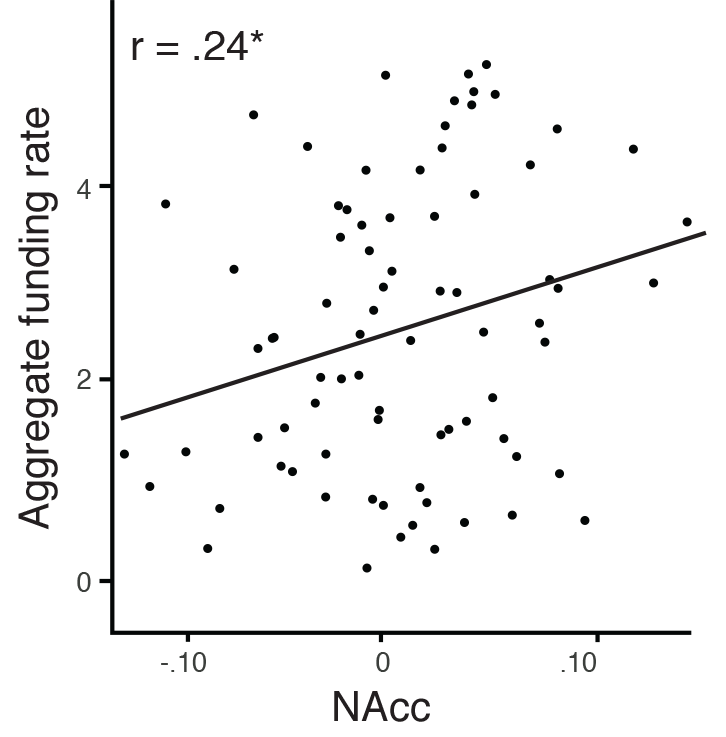 However, microloans do not share these characteristcs, implicating alternate motivations and decision processes. In a series of studies published in Psychological Science we demonstrate that neural affective mechanisms influence microloan request success. In a large internet database of microloan requests, we find that positive affective features of photographs promote loan request success. In a subsequent neuroimaging study we then establish that neural activity (i.e. in the nucleus accumbens) and self-reported positive arousal predict loan request success on the internet, above and beyond choice. These findings suggest that elicitation of positive arousal can promote loan request success, both in the laboratory and on the internet. They also highlight affective neuroscience's potential to probe neuropsychological mechanisms that drive microlending, enhance the effectiveness of loan requests, and forecast market-level behavior.
Charitable Giving and the Identifiable Victim Effect
How do people make decisions regarding charitable giving?
While there are people in need all around the globe, why is it that some people and organizations receive donations and others do not? 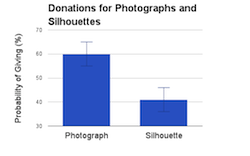 Research by Brian Knutson, Paul Slovic, Daniel Vastfjall and I, published in the Journal of Neuroscience found that including photographs of donation recipients increased charitable giving decisions by evoking positive emotional responses. This increase in giving was predicted by brain activity in a specific region associated with positive feelings and reward (i.e. the nucleus accumbens).
Scaling to Predict Market-Level Behavior
Recent advances in neuroimaging methods and analyses represent a significant opportunity for research to provide consumer insights and to inform real-world marketing decisions with practical and economically 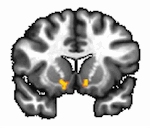 significant consequences. Experimental fMRI studies have enhanced our understanding in a number of highly relevant marketing domains, including the processes underlying valuation and choice. However, questions remain regarding the scalability of conclusions derived from these studies. In particular, do empirical findings provide meaningful insights about the way people behave in the real world when confronted with decisions? Further, do these empirical findings represent economically significant effects in large real-world samples? To address these open questions I am using neuroimaging methods to predict market-level behavior.