
 |
|
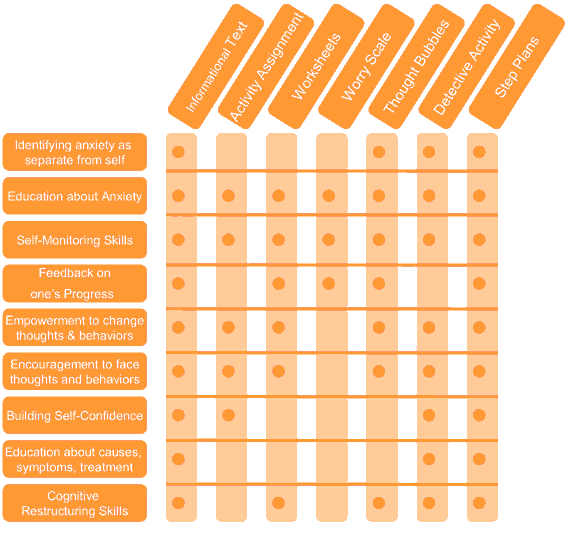
Appraisal: Manualized Cognitive-Behavioral Treatment programs for children with anxiety are supported by dozens of formal empirical studies (Ollendick and King, 2000). The "Cool Kids Program" workbook foolows established norms for CBT and child anxiety, and , thus, is likely to be effective in its treatment of the disorder. However, the workbook is not without its weaknesses. Text: The workbook is extremely text-heavy, and the text itself is not distinctly chunked into manageable bits of information. Thus, the reading component is not the most effective or digestible for its child audience. As illustrated on the House of Quality, the workbook relies on informational text to fulfill the majority of the user’s needs. Manualized Cognitive-Behavioral Treatment programs for children with anxiety are supported by dozens of formal empirical studies (Ollendick and King, 2000). The "Cool Kids Program" workbook foolows established norms for CBT and child anxiety, and , thus, is likely to be effective in its treatment of the disorder. However, the workbook is not without its weaknesses: Uniformity: The composition of the workbook does not vary much across sessions. The repetition of charts and activities is lacking in motivational value. Isolation: Although the child’s therapy is guided by a parent or grandparent, the workbook does not provide opportunity to share with and learn from other children. Unsupervised: The workbook format allows the child the opportunity to skip through sections of the workbook and complete the activities anachronistically. This behavior could interfere with the therapeutic process and result in the ineffectiveness of the therapy >>>>>>>>>>>>>>>>>>>>>>>>>>>>>>>>>>>>>>>>>>>>>>>>>>>> |

|
|
|
House of Quality Analysis: Workbook features are listed on the X Axis and are matched with potential educaional needs on the Y Axis. |
|