|
Candidate
Team Projects - 2026
General Team Project
Information
- Team Projects are for suitable for
three students taking the course for three credit units.
- These projects will be "pitched" in
class on Thursday, January 8th.
- Project suggestor email addresses
will be communicated to the student project team who chooses the
project.
- "Recommended Skillset" is dependent
on the selected design concept.
Index of Candidate Team
Project Titles (year originally suggested)

Back to top
 Projects with Abby Projects with Abby
-
2026 Biosketch: Abby
is an artist, retired art educator from K-College, clinical social worker, and
computer graphic designer. She is an individual with mobility challenges and a
visual impairment. She is passionate about making a difference and advocating
for individual rights. She has served on the Board of Directors of
National Alliance on Mental Illness
Santa Clara County (NAMI SCC) and Silicon Valley
Independent Living Center (SVILC). She has volunteered for the
Vista Center for the Blind and Visually
Impaired, and successfully been involved in litigation to preserve the
rights of service dog recipients when they are hospitalized. She presented a
poster event at NAMI's National Convention 2015, a workshop at California
#ADA25 Conference | DO network, San Francisco, CA, the California Council of
the Blind's Annual Convention 2015, and
Cal Poly Tech Women in Business,
Defining Her Future 2021 panel on Diversity, Equity, and Inclusion. Abby
has partnered with high school students designing assistive technology (Project
Invent and DC Design LTD's Design the Future} and consulted with 7th and
8th grade students designing for accessibility. Abby invented a board game for
inpatient psychiatric units. She has had two service dogs from
Canine Partners for Life (CPL) in
Cochranville, PA, and has presented
Service Dog
Demonstrations at Abilities Expo in 2018 and 2019. Abby completed a
graduate program at California State University
Northridge (CSUN) studying
Assistive Technology
Studies and Human Services, and presented at CSUN's 38th, 39th, and 40th
Assistive Technology Conferences on: How to Teach Compassion with Assistive
Technology (2023), The Importance of the User in the AT Design
Equation (2024), Design AT: Increase Attitudes for Individuals with
Disabilities (2025), and The Joy of 4 Legged AT: Puppy Raising Trainer
and Recipient (2025). Abby joined the faculty of the Assistive Technology
Engineering graduate program at CSUN and taught courses in Current and Emerging
Topics in Assistive Technology and Product Design and Development in Assistive
Technology.
| Back to top
Rain Shield
Project
-
Background: Abby
is an older adult who relies on a powered wheelchair for her mobility and her
service dog, Nathan, to help her with daily tasks.
-
Problem /
Challenge: Wheelchair users and their mobility devices must be protected
from the rain as being wet is uncomfortable and water can damage
electronics.
-
Aim: Explore
designs and fabricate a suitable covering (a garment or wheelchair / scooter
accessory) to protect Abby and her mobility device.
-
Design
Criteria:
- Suitable for use
with Abby's scooter and Whill
- Not an
enclosure
- Aesthetic
design
- Collapsible and
stowable
- Easy to put on and
remove and/or easy to deploy and retract
-
Search Link:
"rain protection for wheelchair user"
-
Recommended
Skillset: Mechanical Engineering, Shop
|
| Back to top
Laptop Storage
-
Background:
Wheelchair users, like Abby, require storage space for many large and small
accessories such as a coat, laptop, keys, cellphone, water bottle, as well as
items for their service dogs including treats, food, blanket, leash, water
bowl, etc.
-
Problem /
Challenge: Current storage solutions for larger items, especially for
laptop computers, are typically backpacks attached behind the wheelchair seat,
which makes retrieving them challenging.
-
Aim: Explore and
fabricate alternative storage solutions for Abby's Mac laptop which don't rely
on a backpack attached behind her wheelchair seat.
-
Design
Criteria:
- Device provides
secure storage
- Laptop is easy to
stow and retrieve
- Space to store small
computer accessories (mouse, cables, disc drive, USB C hub
multiport)
-
Links:
-
Recommended
Skillset: Mechanical Engineering, Shop
|
| Back to top
Laptray Artwork
Easel
-
Background: Abby
is an older adult who relies on a powered wheelchair for her mobility and her
service dog, Nathan, to help her with daily tasks.
-
Problem /
Challenge: Abby has been an artist for many years, enjoying drawing and
watercolor painting. However when she is creating art in the community - for
example at Palo Alto's Elizabeth F.
Gamble Garden - she requires a drawing surface attached to her
wheelchair.
-
Aim: Explore
designs and fabricate a wheelchair-mounted easel.
-
Design
Criteria:
- The easel must be
adjustable for flexibility
- The easel must
accommodate art accessories such as brushes
- The easel must be
able to be stored in the backpack on Abby's wheelchair
-
Links:
-
Recommended
Skillset: Mechanical Engineering, Shop
|
| Back to top
Treats for
Nathan
-
Background: Abby
is an older adult who relies on a powered wheelchair for her mobility and her
service dog, Nathan, to help her with daily tasks.
-
Problem /
Challenge: Abby routinely rewards Nathan for continuous training and for
his service with small food treats. However, finding, retrieving, and opening
the treat bag and selecting one treat item can be a struggle for her as the bag
may be stored inside a backpack behind her wheelchair seat and fine hand
dexterity is required to open the treat bag and pull out a small treat. Nathan
is very enthusiastic in taking the treat from Abby's hand. She opens her hand
with the treat in her palm to avoid Nathan from accidentally biting her
fingers.
The reward procedure
starts with Abby pressing a "clicker", followed quickly by giving the treat.
This enables Nathan to associate his good behavior with the
treat.
-
Aim: Explore and
fabricate solutions that would enable Abby to easily and safely reward
Nathan.
-
Design
Criteria:
- Must accommodate
multiple treats
- Must open quickly,
widely, and easily to access treats
- Must close tightly
to avoid spoilage and spillage and release of treat scent
- Must address
Nathan's aggressive treat acquisition behavior
- Must integrate
clicker with treat dispenser
-
Suggestion:
Consider various dispensing and mounting options
-
Links:
-
Recommended
Skillset: Mechanical Engineering
|
| Back to top
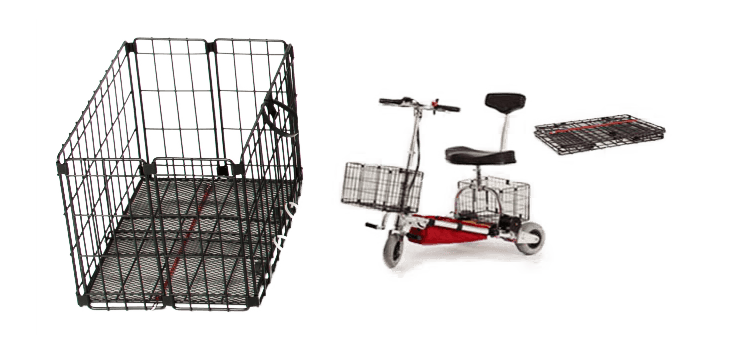
TravelScoot Camping
Basket
-
Background: "I
go camping with my TravelScoot. Its
front-mounted
Foldable Shopping Basket is of wire-frame construction and enables me to
hold and transport water bottles and lunches for Nathan and
me."
-
Problem /
Challenge: Abby reports that her TravelScoot Escape's wire basket is not
sturdy, does not stay together, is difficult to re-assemble, and sticks out
beyond the scooter's frame making it difficult to transport.
"TravelScoot's wire baskets are problematic. I have tried
front and back placement and haven't found them consistent and sturdy. They
also make the scooter more difficult to maneuver with wire ends that get caught
on things."
-
Aim: Explore
designs and fabricate an improved device for transporting
items.
-
Design
Criteria:
- Easy to attach and
remove from the scooter
- Stable when moving
around the camp site
- Foldable for stowing
in a car
-
Other:
-
Recommended
Skillset: Mechanical Engineering, Shop
|
| Back to top
Cutting Board
-
Background:
-
Problem /
Challenge: Due to her limited hand dexterity and strength, Abby has
difficulty cutting vegetables. She notes that the cutting board she currently
uses provides no protection during cutting, does not easily cut the variety of
foods she prepares, and the cut vegetables may fall on the
floor.
-
Aim: Explore
designs and fabricate an improved cutting board.
-
Design
Criteria:
- Lightweight, easy to
clean, and resist food sticking
- Prevent food from
falling to the floor
- Cut a variety of
vegetables
-
Links:
-
Recommended
Skillset: Mechanical Engineering, Shop
|
|
Back to top
Projects with Olenka at the Magical Bridge Playground
Accessible and Inclusive Playground Attractions
-
-
Background: The
Magical Bridge Playground is
recognized as the nation's most innovative accessible and socially inclusive
playground. It is designed to delight the many people who make up our
community, including the 1 in 4 living with a visible or invisible disability
who are typically overlooked in the creation of public playgrounds. It is a
multigenerational play space with areas for respite, along with thoughtful
programs which include
Kindness
Ambassadors. The original playground was spearheaded by Palo Alto citizen
volunteer and former tech executive, Olenka (Villarreal). Along with dozens of
volunteers and 0.8 acres of underutilized public land in Mitchell Park, she was
determined to create the most magical playground to bridge the gap between
those with and without disabilities in such a seamless way that everyone would
love it. Located at
600
East Meadow Drive in Palo Alto, the volunteers raised $4.2M in private
funds to showcase how a truly inclusive playground creates a welcoming spirit
for a community. Magical Bridge Playground is adjacent to
AbilityPath and close to
Ada's Cafe and the
Mitchell Park
Library.
-
The
playground
opened in April 2015 and enjoys an average of 25,000 visitors a month. Many
are local families, while others come from long distances.
-
After this playground was
completed, Magical Bridge
Foundation was formed in 2016 with a mission to advocate for more inclusive
play spaces and programs that consider the needs of all ages and all abilities.
The foundation now has 10 Bay Area playgrounds, as well as one in
Singapore
and one in New Zealand with many more underway. Some of the many local projects
the Foundation is working on include playgrounds for the Morgan Autism Center,
the VTA Center in San Jose, and destination playgrounds in Daly City, San
Raphael, Healdsburg, and many more around the world.
-
Problem /
Challenge: The park's play equipment has been well-received, but some
aspects of the play areas could be modified for better access. In addition,
suggestions for replacement play areas are sought to update the park with
innovative installations every few years. And as new Playgrounds are planned
and constructed, there are ongoing opportunities to design new features and
refine existing designs to be accessible to everyone regardless of their
abilities.
-
Aim: Explore
designs to create new play and educational experiences incorporating multiple
senses, actions, and outcomes for all playground users and visitors, especially
those with visual impairments and diminished fine motor skills.
-
Design
Criteria:
- Designs should be
durable, fun, and safe for everyone - accommodating children and parents with
disabilities - and be magical for all ages and all abilities.
- Project prototypes
could be scale models to facilitate their construction and
transportation.
- Designs that
incorporate electronics should be low-voltage or solar-powered.
- Consider designs for
kids and older adults.
-
Suggestion: Employ
actuators (levers, pulleys, buttons, etc) to activate sound, music, motion,
lights.
-
Recommended
Skillset: Mechanical Engineering, Mechatronics (depends on selected design
concept)
-
Magical Bridge
Playground Links:
-
-
Links to Project
Ideas:
-
|
Back to top
Projects with Gary
-
-
Prosthetic
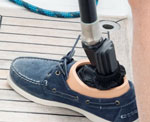
Background: Prosthetic legs designed for lower limb amputees have a foot
usually made of carbon fiber or fiberglass that may or may not be anatomically
shaped. A special "spectra sock" is put over the foot to reduce sound produced
by the foot rubbing against the rubber foot shell fitted over it. The foot
shell is inserted into a commercial shoe.
-
-
User Background:
Renee is a single limb below-the-knee amputee who lives in Mountain View. She
likes to walk barefoot (taking off the shoe on the other foot) on
the beach and at home. She would like to be independent in the care of her
prosthetic leg which includes removing the foot shell and sock for
cleaning.
Foot Shell
-
-
Problem /
Challenge: The spectra sock is an important part of the foot and foot shell
but it accumulates water, dirt, sand, and odor. It needs to be removed,
changed, and cleaned on a regular basis.
However, most foot shells
are extremely difficult to take off and put on (even when using a specialized
too), making changing of the spectra sock impossible for most users and
requiring a visit to the prosthetist - who may need 15 minutes to complete the
task, even with a special tool.
-
Aim: Explore
designs and fabricate prototypes for a foot shell that can be easily removed by
Renee.
-
Design
Criteria:
- easy to take off and
put on by Renee and other amputees who may have limited strength &
dexterity
- stable during walking
activities over time
- fits well in
shoes
- unable to be placed
incorrectly, causing instability
- provides an indication
of being locked in place
- exhibits positive
cosmesis
-
Recommended
Skillset: Mechanical Engineering, Shop, depends on selected design
concept
Barefoot
-
-
Problem /
Challenge: Prosthetic feet are typically not designed to be used without
shoes (barefoot) and can be difficult to use in barefoot environments such as
at home or the beach as the 3/4" heel height with a shoe disappears when
barefoot, creating a front to back "tilt".
-
Aim: Explore
design and fabricate solutions that would enable Renee to walk barefoot safely
and comfortably.
-
Design
Criteria:
- easy to take off and
put on by Renee and other amputees who may have limited strength &
dexterity
- stable during walking
activities over time
- resolves the "tilt"
problem
- exhibits positive
cosmesis
-
Recommended
Skillset: Mechanical Engineering, Shop, depends on selected design
concept
-
Links:
|

Back to top
Project with Kent
Transporter for Kent
-
-
Background: Kent
is a power wheelchair user and is active in the Stanford Chapter of the FSHD
Society.
-
Problem /
Challenge: At the conclusion of the May 2025 FSHD meeting, Kent was tasked
with carrying unused soda cans, cookie treats, plates, napkins, and utensils
out of the room. He stacked all the items precariously on his lap and hoped
that nothing would fall off as he exited the room, took the elevator to the
lobby, and proceeded to his car.
-
Aim: Explore
designs and fabricate prototypes that would allow Kent to confidently carry
items without concern for dropping them.
-
Design
Criteria:
- Fit on his wheelchair
- 2018 Heavy Duty Fold & Go Electric Wheelchair
- Offer a stable
platform
- Accommodate items of
various sizes and weights
- Off-load the weight of
carried items from his lap
- Be compact and
collapsable
- Will not interfere
with controlling the wheelchair
-
Note: The
prototype could also be used when shopping.
-
Recommended
Skillset: Mechanical Engineering, Shop, depends on selected design
concept
-
Link:
|
Back to top
Projects with Danny
-
Background: Danny is a
wheelchair user from Los Gatos with cerebral palsy. He experiences limited
upper body strength, grip & vision impairments, and diminished hand &
finger dexterity.
|
Back to top
Poop Management for Danny's Service Dog Korey
-
Problem /
Challenge: Wheelchair users who walk their dogs need to clean up after
them. Danny's limited hand / arm strength and reduced mobility affects his
ability to successfully perform both the collection and bagging portions of
this task.
-
Aim: Explore
designs for a poop management system for Danny's service dog
Korey.
-
Design
Criteria:
- Consider sanitation
and odor issues
- Easy for Danny to
use
- Simple in design,
low-cost, lightweight, able to store on his wheelchair
-
Recommended
Skillset: Mechanical Engineering, Shop
-
Links:
- Search for "poop
management for service dogs"
|
|
Back to top
Treats for Korey
- Background:
Danny benefits from the help of his service dog, Korey.
-
Problem /
Challenge: Danny would like to routinely reward Korey for his service with
small food treats. However, finding, retrieving, and opening a treat bag and
selecting one treat item can be a struggle for him as the bag may be stored
inside a backpack behind his wheelchair seat and fine hand dexterity is
required to open the treat bag and pull out a small treat.
-
Aim: Explore
solutions that would enable Danny to independently reward Korey.
-
Design
Criteria:
- Consider alternative
treat delivery mechanisms.
-
Recommended
Skillset: Mechanical Engineering, Shop
-
Links:
|
|
Back to top
Water Bottle Opener for Daniel
- Background:
Daniel is a wheelchair user from Los Gatos with cerebral palsy. He experiences
limited upper body strength, grip & vision impairments, and diminished hand
& finger dexterity
-
Problem /
Challenge: Stanford, Daniel's brother, says, "Existing electric bottle
openers on the market require dexterity, visual acuity, and the function of two
hands. Many times Danny has simply tried to bite off the cap of a plastic water
bottle to drink water independently. I usually lovingly admonish such actions,
suggesting it is better for his teeth if he asks for
assistance."
-
Aim: Explore
designs that would enable Daniel to independently open a water
bottle.
-
Design
Criteria:
- The device could
fitted to Daniel's wheelchair or reside in the kitchen.
- The wheelchair
solution should be self-powered.
-
Recommended
Skillset: Mechanical Engineering, Shop
-
Links:
|
|
Back to top
Obstacle Detector
- Background:
Danny relies on his
Permobil
M3 Corpus Power Wheelchair for independent mobility.
-
Problem /
Challenge: Danny uses a powered wheelchair to get around independently. His
vision impairment makes it challenging for him to identify upcoming curbs and
locate the curbcut, especially at night in dark communities, like on the campus
of Stanford University. In addition, he often can not detect obstacles in his
path and side drop-offs.
-
Aim: Explore
designs to detect obstacles and alert Danny.
-
Design
Criteria:
- The device must be
easy to attach to his powered wheelchair.
- The device must be
powered by an internal battery.
- The device must be
reconfigurable for obstacles, curbs, and drop-offs.
-
Recommended
Skillset: Mechatronics, Mechanical Engineering, Shop
-
Links:
|
|
|
Projects Suggested by Dave:
|
Back to top
Designing Your
Afterlife
-
Background:
Death is the most severe form of disability as one is no longer able to
interact with people or physical objects in the living world. What remains are
only frozen static artifacts - images, writings, and the stories of others.
Gone are one's personality, beliefs, expertise, humor, vision, memories,
insights, and intellect.
-
Problem /
Challenge: With one's passing, it is impossible to provide a full and
accurate representation of whom they were, what they believed in, and how they
acted. The recollections of family and friends fade and disappear with time,
leaving the departed one's legacy at the mercy of the living.
-
Aim: Explore
ways to preserve one's essence after death. In the technology extreme, this
might manifest itself as an interactive system that responds to queries,
retells stories, relates experiences, shares expertise, and expresses humor.
The pre-dead user would be able to create and program his / her eternal
computer-based persona before her / his demise.
-
Other:
-
Recommended
Skillset: Various, depends on chosen solution
-
Links:
|
|
Back to top
Creative
Expression
-
Background: Most
everyone has a desire to be creative through activities such as writing,
painting, sculpture, pottery, jewelry, quilting, photography, singing, dancing,
and music.
-
Problem /
Challenge: Existing tools supporting creativity are often lacking for
people with disabilities. Movement difficulties may prevent an individual from
fully participating in their chosen activity.
-
Aim: Explore
ways to enhance creative expression for people with disabilities. This could
include the creation of new activities or fabrication of new
tools.
-
Suggestions:
- Convert the user's
existing assistive technology device into a creative "paintbrush" or "musical
instrument"
- Use non-traditional
inputs such as residual movements or brain waves
- Adapt or create
instruments for musicians with disabilities
- One-Handed Musical
Instrument (OHMI) Competition
-
Other:
-
Recommended
Skillset: Various, depends on chosen solution
-
Links:
|
|
Back to top
Student-defined
Projects
-
- Meet with the course
instructor to discuss and agree upon the specifics of the project. Interview,
observe, and discuss assistive technology problems with an individual with a
disability or older adult. Address their desire to participate in one of the
following activities by designing an adaptation to an existing device / tool or
creating a new, more useful one. Projects could address:
-
-
Activities
of Daily Living - cooking, showering or bathing, dressing, cleaning,
housework, yard work, employment, education, shopping, commuting,
etc
-
Sports and
Exercise - walking, running, indoor and outdoor sports, etc
-
Leisure
Activities and Hobbies - collecting, model making, crafts, board games
& videogames, etc
|
|
|
Back to top
Title
-
Background:
-
Problem / Challenge:
-
Aim:
-
Design Criteria:
-
Links:
|
Back to
top
|