My current research focuses on design, modeling and control methods of a novel three phase multilevel inverters (MLIs) for renewable energy applications.
To date, three phase MLIs have been designed with single phase inverter modules with large DC-link capacitors as energy buffer or with three phase inverter modules that connect DC source to all three phases to eliminate the need for large input capacitors (Fig. 1-2)
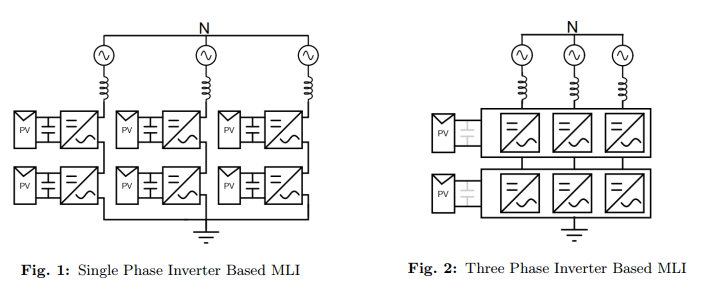
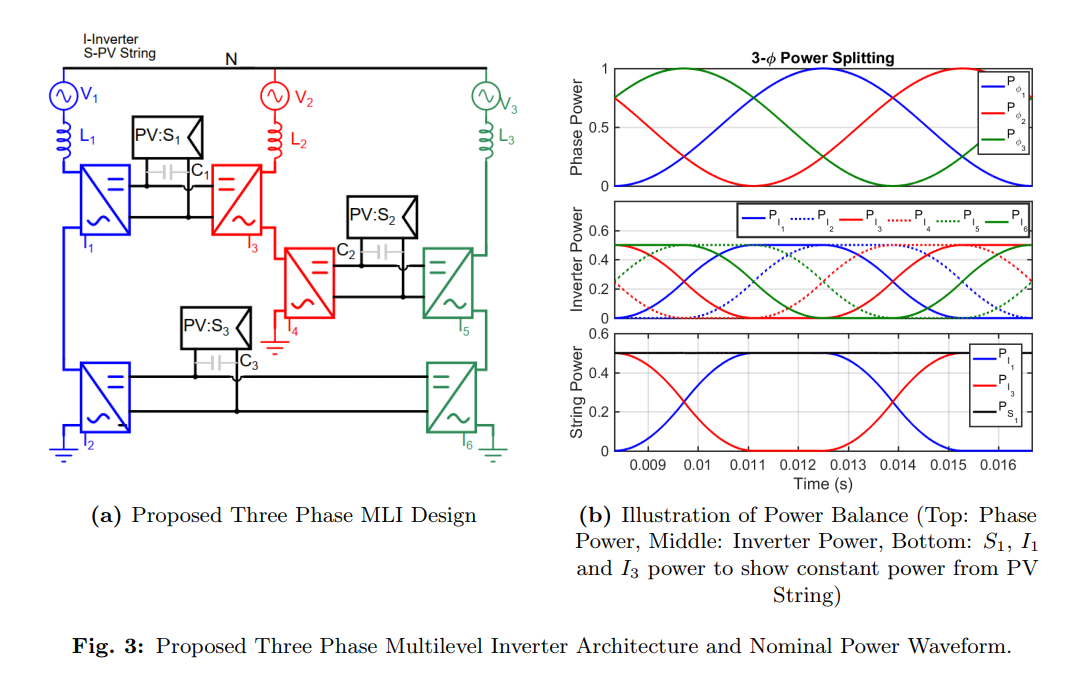
We explore a new multi-level converter architecture as shown in Fig. 3a, where each DC source only connects to two of the three phases. As long as there are an equal number of PV arrays connecting to phase 1-2, phase 2-3 and phase 1-3, we can still attain power balance at the DC link as shown in Fig. 3b. The value of this new architecture is two-fold: 1) as shown in Fig. 3b, the converters operate at peak or zero power for most of the AC cycle, resulting in higher efficiency and 2) this design can serve as a natural fault handling for the 3-phase MLI (Fig. 2) if one of the three converters on the same DC bus fails.
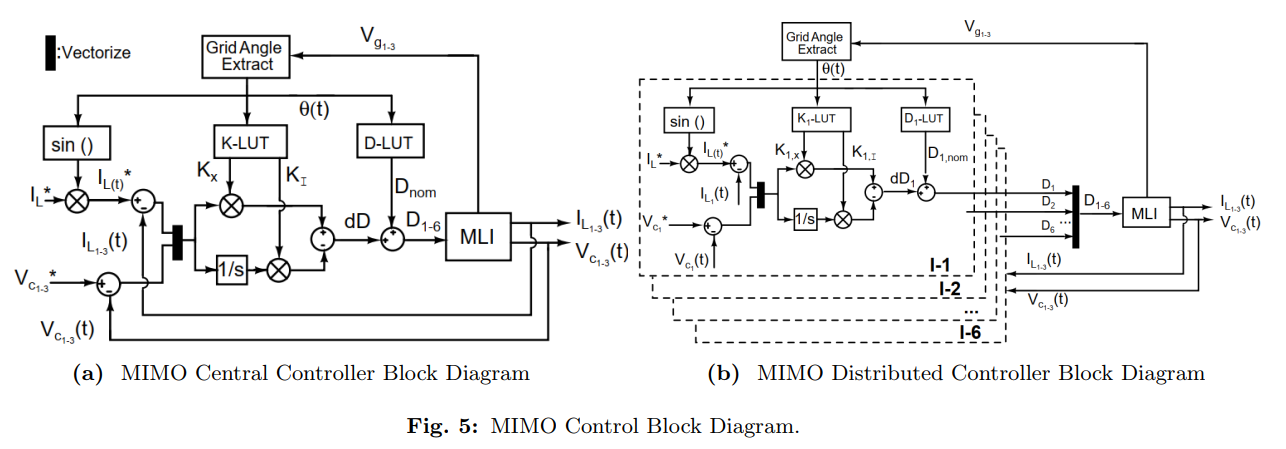
We propose a novel control strategy that is multiple-input-multiple-output (MIMO) in nature to track DC link voltages and grid currents simultaneously. We derive the control law and show simulation in PLECS to demonstrate the nominal and transient operation of our design. We also show a simplified, distributed version of the control that only requires each converter to measure its own PV voltage and phase current.
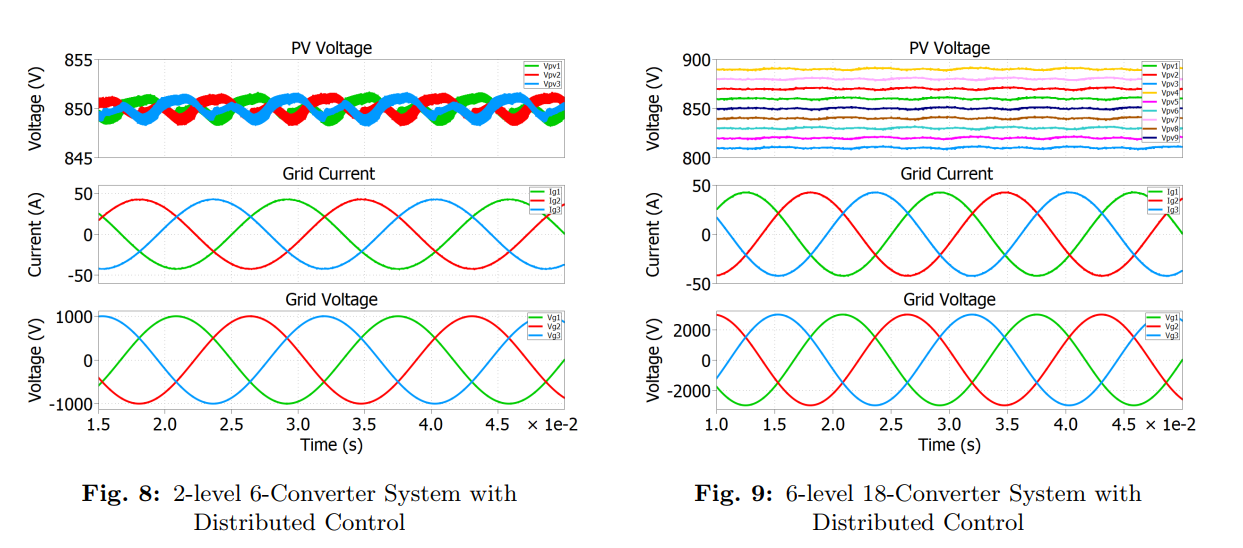
With the proposed controller, we built a 110V DC input, 208V 3-phase AC output, 1kW, 6 inverter module hardware prototype to demonstrate the design. The individual inverter module consists of a dual active bridge DC-DC stage for galvanic isolation and an inverter stage for regulating output current. A backplane is also designed to cononect six inverter modules in the proposed system level design.
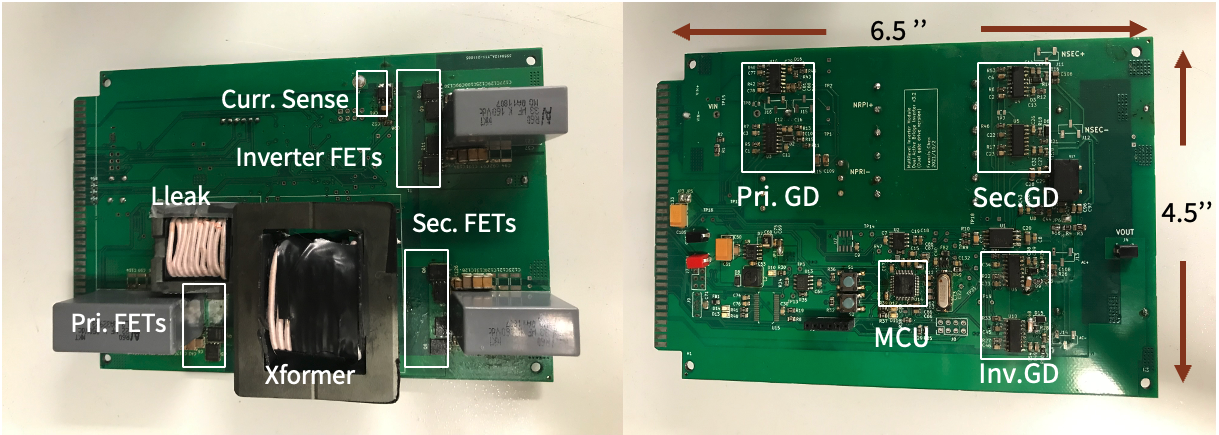
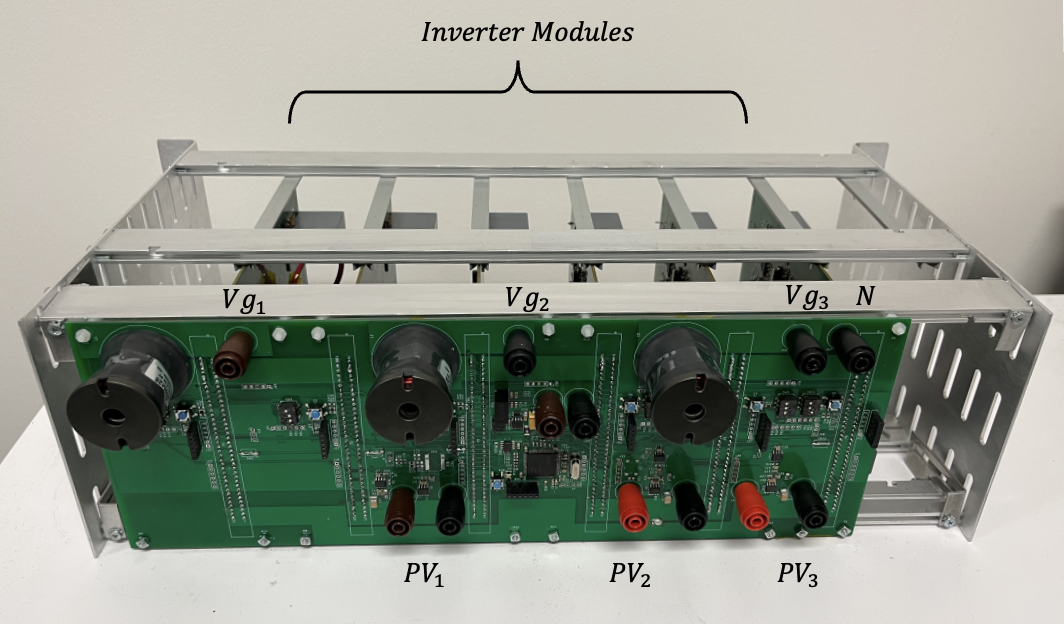
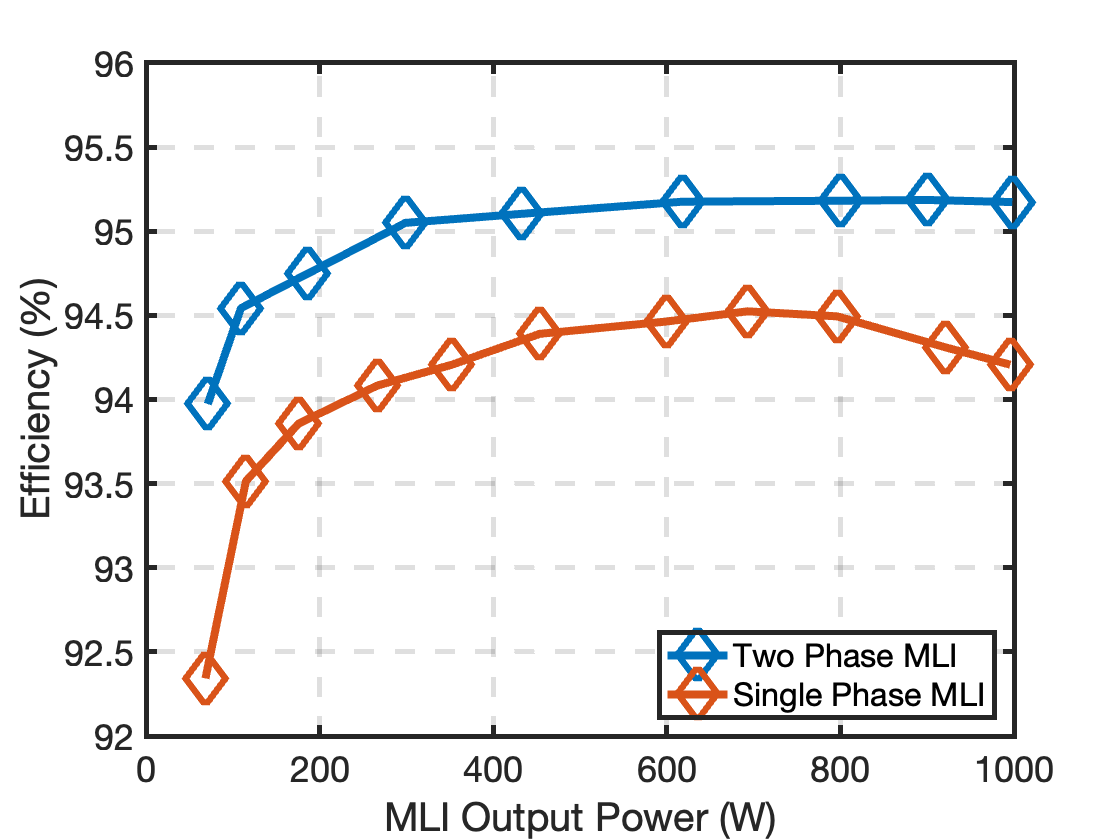
We compared the proposed design with the traditional stacking scheme where all inverter modules share phase power evenly. We demonstrate that due to the fact that the proposed design allow inverter to operate at peak or zero power for most of the AC cycle, it results in higher efficiency across all power levels. In particular, the proposed MLI design allow more than 25% loss reduction at lower power.