Section #1: Karel the Robot
September 20th, 2020
Based on handouts by Eric Roberts and Marty Stepp and converted to Python by Brahm Capoor
This week in section, your first priority is to meet your section leader and discover what sections in CS106A are all about. Your section leader will therefore spend the first part of this week’s session on introductions and telling you the things you need to know, such as how to sign up for interactive grading. Afterwards, they will move on to cover some of the important material from class in a setting that is small enough for you to go over practice problems and ask questions. This week, your goal is to solve Karel problems that involve stepwise refinement, also known as top-down design.
Hospital Karel
Countries around the world are dispatching hospital-building robots to make sure anyone who gets sick can be treated. They have decided to enlist Karel robots. Your job is to program those robots.
Karel begins at the left end of a row that might look like this:
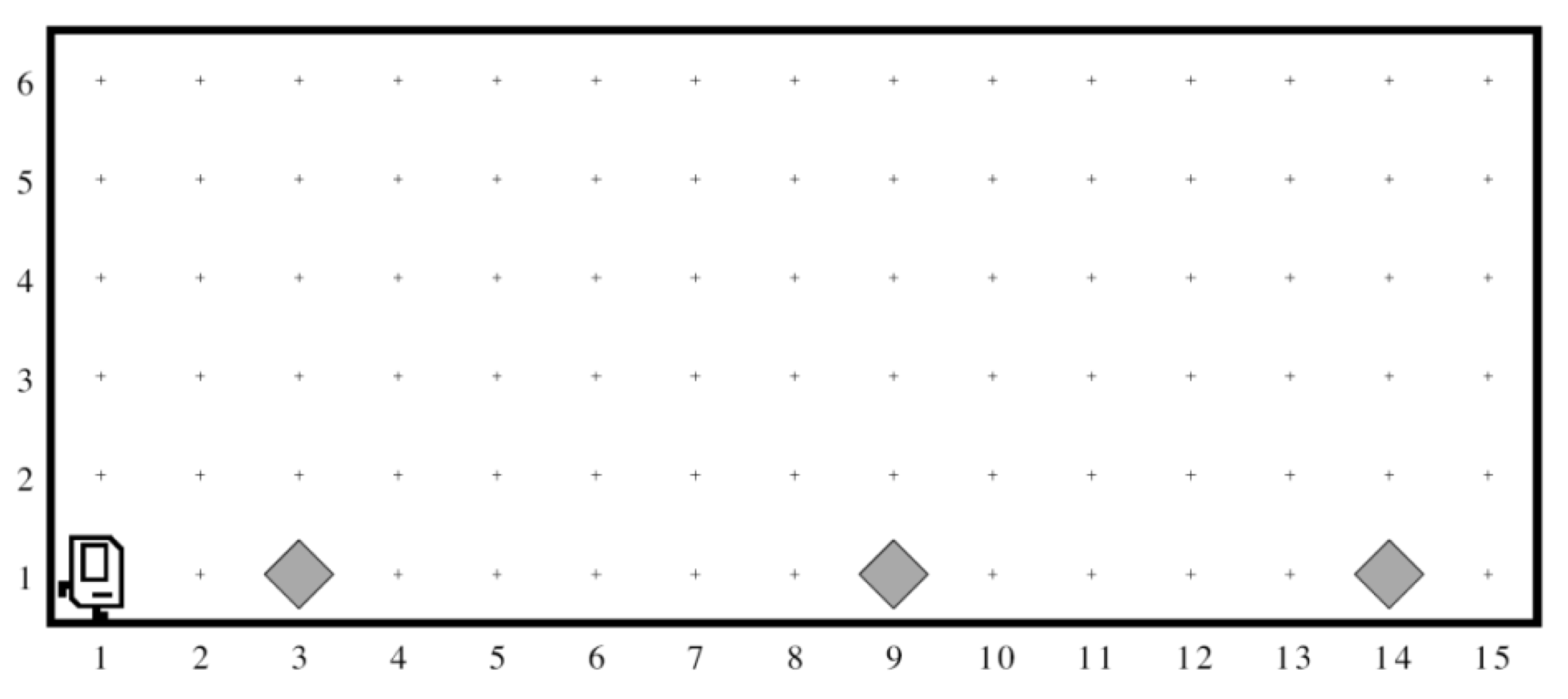
Each beeper in the figure represents a pile of supplies. Karel’s job is to walk along the row and build a new hospital in the places marked by each beeper. Each hospital should look exactly like this:
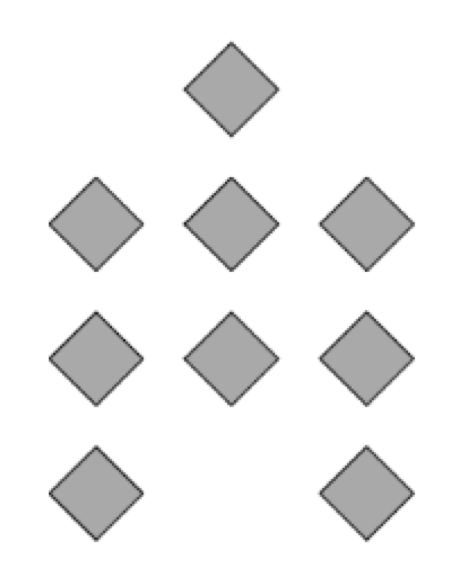
The new hospital should be centered at the point at which the bit of debris was left, which means that the first hospital in the diagram above will be constructed with its left edge along 2nd Avenue. At the end of the run, Karel should be at the east end of the street having created a set of hospitals that look like this for the initial conditions shown:
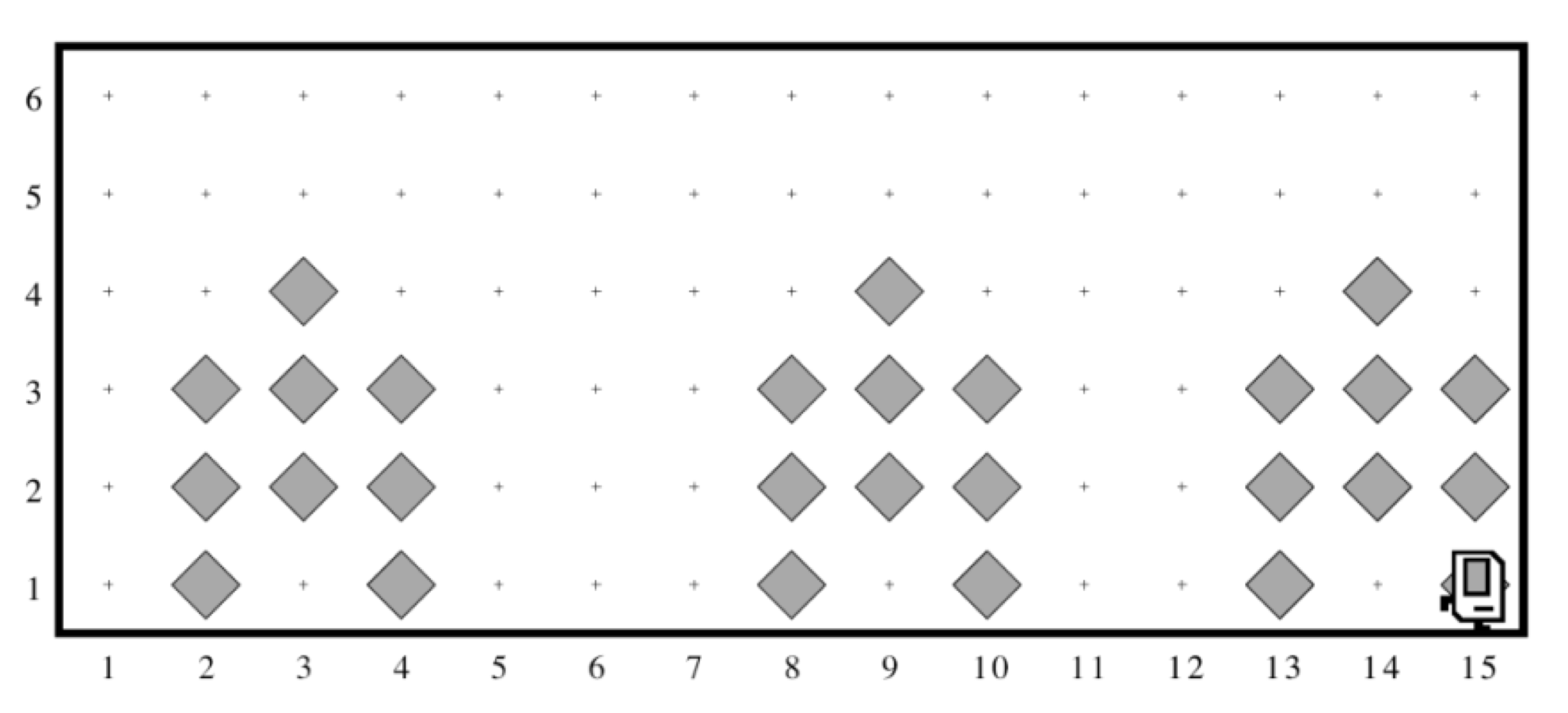
Keep in mind the following information about the world:
- Karel starts facing east at (1, 1) with an infinite number of beepers in its beeper bag.
- The beepers indicating the positions at which hospitals should be built will be spaced so that there is room to build the hospitals without overlapping or hitting walls.
- You will not have to build a hospital that starts in either of the last two columns.
- Karel should not run into a wall if it builds a hospital that extends into that final corner.
Write a program to implement the Hospital Building Karel project. Remember that your program should work for any world that meets the above conditions.
Karel Defends Democracy
The 2000 Presidential Elections were plagued by the hanging-chad problem. To vote, voters punched columns out of a paper ballot; but if they only punched partially, the column was left hanging. Luckily, Karel is here to save the day!
In Karel’s world, a ballot consists of a series of columns that a voter can “punch out”. Karel starts on the left of a ballot and should progress through each column. If a column contains a beeper in the center row, the voter did not intend to vote on that column, and Karel should move to the next column. However, if a column contains no beeper in the center row, Karel must make sure that there is no hanging chad. In other words, Karel should check the corners above and below and remove any beepers. A corner may contain any number of beepers. Karel must finish facing east at the rightmost edge of the ballot.
An example initial world is shown on the left below. The world on the right below shows what Karel’s final world should look like (when given the initial world on the left).
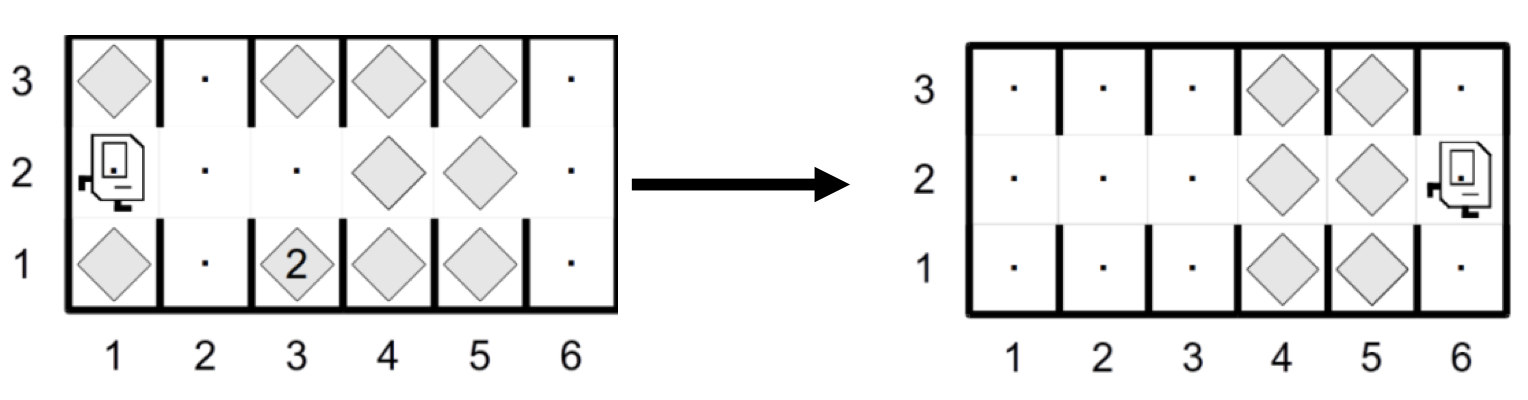
Keep in mind the following information about the world:
- Karel starts facing east at (1, 2) with an infinite number of beepers in its beeper bag.
- Karel must end up facing east at the end of 2nd street
- The world consists of an arbitrary number of 3-height columns only; Karel can travel along the middle row without hitting a wall.
Your program should work for any world that meets the above conditions.