

 |
||||||||||
| Plasmas and Materials Processing | ||||||||||
| Plasmas and Materials Processing Ned Hammond Plasmas exhibit a rich variety of complex, non-linear behavior and are heavily used in industry. Applications of plasma processing are quite broad; the ability of a chemically active plasma to change the surface properties of materials plays a key role in such industries as aerospace, automotive, steel, biomedical, and toxic waste management. For example, a plasma can be used to harden a surface to improve wear resistance. Another way that the plasma can affect a surface is to break down a gas to make it more reactive; the radical components of the gas then react with the surface and either remove or deposit material on the surface. The objective of this work is to develop a conservative numerical algorithm that provides a robust, rapid, and accurate solution to the plasma fluid equations. To date, an unsteady, multi-dimensional plasma simulation has been written. Most of the work is computational, but some of the work is theoretical. You need to know the theory (and have a good background in math) to understand what the computational results are telling you and also to understand why the computational methods work or don't work. |
||||||||||
 |
||||||||||
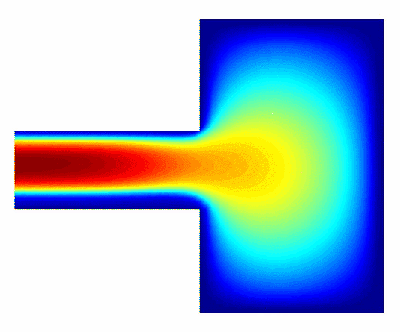
| This picture shows electron number density in a capacitively-coupled plasma reactor. The reactor is used to create and contain the plasma. The geometry is based on the GEC Reference Cell configuration. This reference cell is a "standard" design which resembles the plasma reactors used in industry, and it is used often in experiments, so most available experimental data are from this geometry. The simulation is two-dimensional with cylindrical coordinates (the centerline is to the left, and the outer diameter of the reactor is to the right). | ||||||||||
|
|
||||||||||

- Computational Acoustics
- Viscous Fingering in a Reacting System
- Plasmas and Materials Processing
- LES Methods
- Numerical Simulation of Environmental Flows
- Combustion
- Very Large Scales in Turbulent Wall Flows
- LES of Turbomachinery
- Structure Based Turbulence Model
- Numerical simulation of heat transfer around film-cooled gas turbine blades
|
Center for Turbulence Research | Center for Integrated Turbulence Simulations
Accelerated Strategic Computing Initiative  Flow Physics & Computation, Mechanical Engineering Department, Stanford University, Building 500 Stanford, California 94305-3030 Mechanical Engineering | Chemical Engineering | Aeronautics & Astronautics |
|

