| |
001. |
|
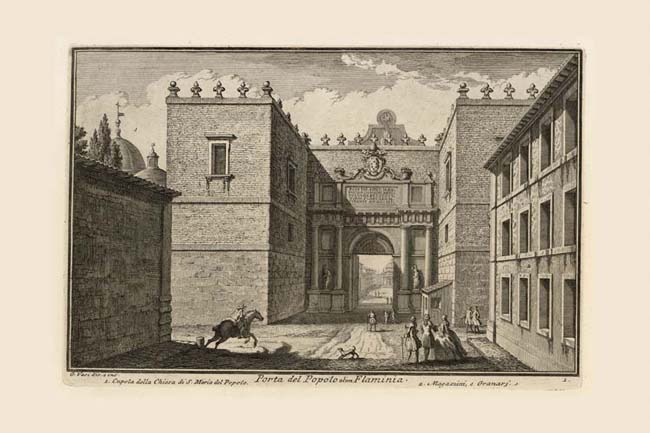
Porta del Popolo olim Flaminia |
|
 |
|
 |
|
 |
|
| |
|
Porta del Popolo |
| |
1. |
S Maria del Popolo |
| |
2. |
Magazzini, e Granarj |
Porta Flaminia is one of the 3rd century gates in the Aurelian walls, spanning the Via Flaminia, which approaches Rome from the north. It underwent a number of radical transformations from the Renaissance on. The gate as shown, designed by Nanni di Baccio Bigio, features the triumphal arch motif, surmounted by the Medici arms of Pope Pius IV (1559-65), and bears the inscription:
PIVS . IIII . PONT . MAX
PORTAM . IN . HANC . AMPLI
TVDINEM . EXTVLIT
VIAM . FLAMINIAM
STRAVIT . ANNO . III
Pius IV Pontifex Maximus widened the gate
and paved Via Flaminia in the third year of
his pontificate.
Above the gate can be seen the top of the coat of arms of Alexander VII Chigi (1655-67). Its twin design on the opposing side faces Piazza del Popolo, Plate 21, and constitutes part of the interior facade of the gate by Bernini created to commemorate the entry into the city of Queen Christina of Sweden in 1655. The two massive towers flanking the exterior of the gate were demolished in 1879 to make way for two arched pedestrian openings into the piazza. In the upper left corner of the print Vasi shows two cupolas, the larger belonging to S. Maria del Popolo (1) NN 401, the smaller displaying the lantern of the 16th century Chigi Chapel. Visible through the central arch is the church of S.Maria di Montesanto, as well as the left side of the piazza, which was demolished in the early 19th century reshaping of the piazza. A more complete view of these features can be seen in the closely related view of Piazza del Popolo, Plate 21A, looking down the axis of Via del Corso. The late 19th century urban space just outside the gate, the Piazzale Flaminio, replaced the two flanking buildings in the immediate foreground, including the granary (2) on the right.
|
