|
| |
1. |
Obelisco Egizio |
| |
2. |
S Maria del Popolo |
| |
3. |
Porta del Popolo |
| |
4. |
S.M. dei Miracoli |
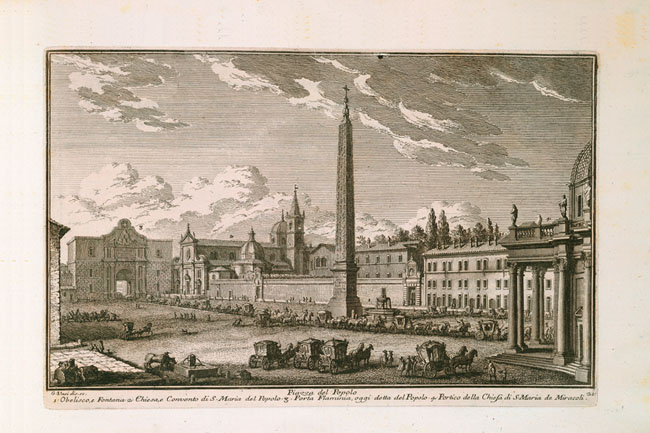
Porta del Popolo (3) has always been the major entrance to Rome from the north. Piazza del Popolo was therefore the first view of the city that pilgrims and visitors obtained after passing through the gate. This angled view that Vasi presents is taken from a point which is almost diametrically opposite to the more famous print by Piranesi. Vasi also drew two more symmetrical views of the piazza and of the trivium of streets radiating from it. One is a companion plate to the one under discussion, Plate 21A, and the second is a small print which adorns the title page of this, his second volume of the Magnificenze, dedicated to piazze. Yet a fourth reference to the piazza is to be found in the first print of the first volume: Porta del Popolo, Plate 1, seen from the exterior. The multiple references to this piazza is both an indication of its importance and a suggestion of an urban sequence, continued by successive prints in this volume, which takes the entering visitor on an extended tour of the city, piazza by piazza. This is also suggested by the long procession of coaches in this view, seen coming from the gate and entering the Via del Corso (the ancient Via Flaminia, medieval Via Lata), along whose axis one finds the next three piazze in the series. Bernini is responsible for the triumphal arch design of the interior facade of Porta del Popolo, which commemorates the 1655 entry of Queen Christina of Sweden when she came to Rome after abdicating her throne, and converted to Catholicism. Pope Alexander VII (1655-67) whose great coat of arms of six hills and star shapes the Bernini design for the top of the gate (also influenced by Michelangelo's interior facade of Porta Pia), received the Queen in great state since her decision signified a significant religious victory over the Protestants. Moving to the right, we see the church of S. Maria del Popolo (2) whose Renaissance facade was embellished with Baroque volutes by Bernini. The obelisk (1) placed at the convergence point of the axes of the three trivium streets under Sixtus V (1585-90) was originally brought to Rome by Augustus to adorn the spina of the Circus Maximus. Sixtus V is also responsible for the fountain next to the obelisk on the axis of Via del Corso. Facing the piazza on its sourthern edge we see the porch of S. Maria de' Miracoli (4). During the period of Napoleonic domination of Rome the piazza was given a different configuration, its trapezoidal shape being altered into a large oval with the long axis passing through the obelisk, perpendicular to the axis of Via del Corso, as shown in the modern photograph. Valadier, the Italian architect who succeeded the French Berthault in the redesign of the piazza, replaced the single fountain with four smaller ones at the corners of the square base of the obelisk.
|


