| |
021a. |
|
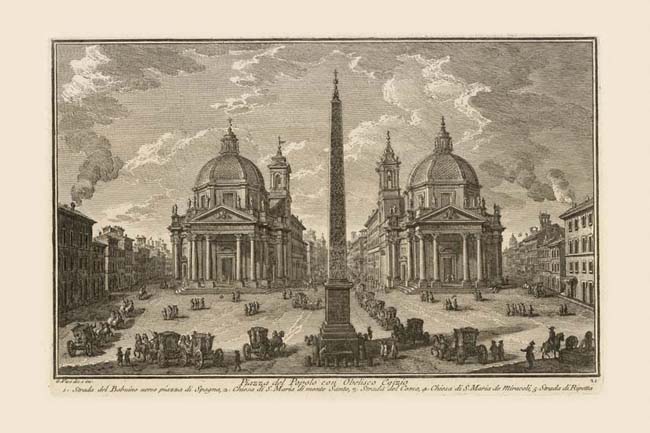
Piazza del Popolo con Obelisco Cyizio |
|
 |
|
 |
|
 |
|
| |
|
Piazza del Popolo |
| |
1. |
Strada del Babuino verso piazza di Spagna |
| |
2. |
S.M. di Montesanto |
| |
3. |
Strada del Corso |
| |
4. |
S.M. dei Miracoli |
| |
5. |
Strada di Ripetta |
| |
-. |
Obelisco Egizio |
This frontal view of Piazza del Popolo highlights the near symmetry of the twin churches, from left to right, of S. Maria di monte Santo (2) and S. Maria de Miracoli (4). This print is a pendant version of Plate 21 which shows the same piazza at an oblique angle looking north. Vasi’s view of the piazza looks down Via del Corso (3) with the obelisk brought to Rome by Augustus and Sixtus V (1585-90) at its center. This view emphasizes the role of the piazza as the traditional "urban vestibule" that pilgrims, dignitaries and others would experience as their first image of the Eternal City when entering from the north (the traditional entry into the city). From here the trident of streets led off to the Sette Chiese or seven pilgrimage churches. While the central procession of carriages in the print heads down the Via del Corso (3) to Piazza Venezia, Plates 39, 65, the carriages on the left are about to enter the Strada del Babuino (1) and on to the Piazza di Spagna, Plates 40, 40A. Veering off to the right, a single carriage is about to follow the Strada di Ripetta (5) which intersects with the Porto di Ripetta, Plate 85, at the tangent of the Tiber.
|
