| |
021b. |
|
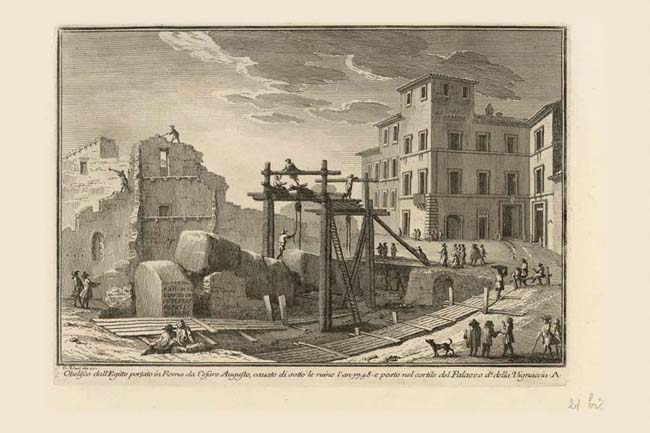
Obelisco dall'Egitto portato in Roma da Cesare Augusto, cavato di sotto le ruine l'an 1748 e posto nel cortile del Palazzo d.o della Vignaccia A |
|
 |
|
 |
|
 |
|
| |
|
Obelisco dall'Egitto portato in Roma da Cesare Augusto, cavato di sotto le ruine I'an. 1748 |
| |
1. |
Palazzo d/o della Vignaccia.A |
Both Nolli and Vasi give us a considerable amount of information about this obelisk. Nolli refers to it as obelisco solare giacente (prone solar obelisk: NN 344), the "solar" referring to the fact that it was used in antiquity as the gnomon for a gigantic sundial on that site in Campo Marzio. Vasi informs us that it was brought to Rome from Egypt (Heliopolis) by Augustus (31 BC–14 AD), and that it was excavated in 1748, the year of the publication of the Nolli map. The map illustrates the obelisk partly under Palazzo Conti (also noted as NN 344), and partly under the adjacent street. The Vasi image shows that building undergoing demolition, and the extraction of the pieces of the obelisk by means of a scaffolding with pulleys. In the caption Vasi notes that the fragments were placed in the courtyard of Palazzo della Vignaccia at right (marked with the letter A). In 1792 the obelisk was restored and mounted in Piazza Montecitorio, Plate 23. The first edition of the Magnificenze shows the piazza without the obelisk but later editions show it in place. The demolished Palazzo Conti was replaced by a new building which still survives. Palazzo della Vignaccia and the adjacent buildings were demolished in the late 19th century during the clearing for Piazza del Parlamento.
|
