|
| |
1. |
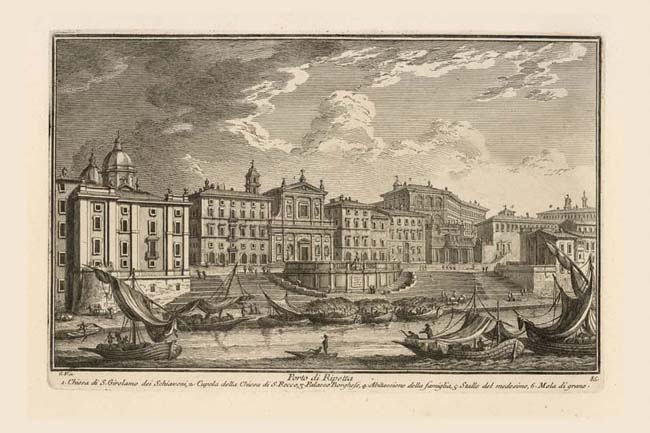
Chiesa di S Girolamo dei Schiavoni |
| |
2. |
Cupola della Chiesa di S Rocco |
| |
3. |
Palazzo Borghese |
| |
4. |
Abitazzione della famiglia |
| |
5. |
Stalle del medesimo |
| |
6. |
Mola di grano |
Begun in 1703, the Porto di Ripetta served as the major river port for boats descending the Tiber from the north. This comprehensive view of Alessandro Specchi's vanished masterpiece can be compared with Falda's 1660's print to see what the site looked like earlier and also with Piranesi's 1750 view for sheer dramatic contrast. Specchi made the axis of symmetry of the port coincide with that of the 1580s church of S. Girolamo degli Schiavoni (1). The semicircular terrace in front of the church which enlivened its rather flat facade, was the central element of the undulating steps cascading down to the river. The building at far left was the Dogana (customs house) for the port. Above it we see the dome of S. Rocco (2) whose facade it hides (see Plate 85A). To the left Vasi indicates the top of another dome, belonging to S. Carlo al Corso, Plate 140. Via di Ripetta, which separates the port from the line of buildings facing on to it, is one of the three streets converging on Piazza del Popolo, Plate 21. Facing on to Via Ripetta at the right end of the port is the short facade of Palazzo Borghese (3) Plate 69, whose bulk looms above it. This elaborate element was started by Flaminio Ponzio and concluded ten years after his death in 1613. Its two story volume constitutes the "keyboard" of the ciambalo di Borghese, the popular reference for the palazzo whose plan and volume does indeed resemble that of an harpsichord. To its right Vasi shows the mola di grano (6) (grain wharf) used for unloading wheat and other grains from the upper reaches of the river. The stables (5) and the servants' building (4) complete the Borghese complex. At the extreme right above the roof tops we see the column of Marcus Aurelius in Piazza Colonna, Plate 22.
|


