| |
084. |
|
Ponte Milvio, detta Ponte Molle |
|
 |
|
 |
|
 |
|
| |
|
Ponte Milvio detto Ponte Molle |
| |
1. |
Via Flaminia |
| |
2. |
Via Angelica |
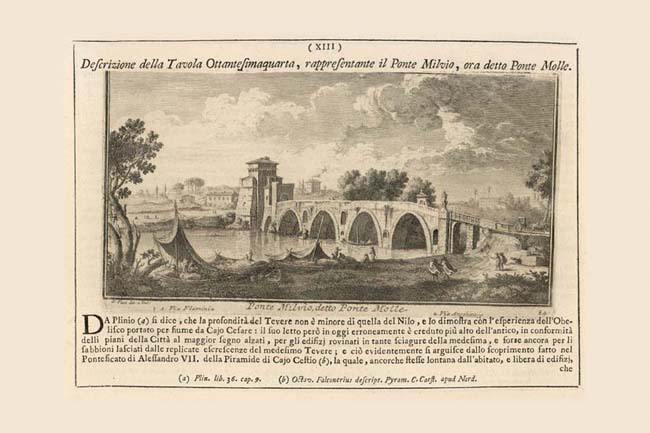
The ancient Pons Mulvius or Ponte Milvio was a key bridge outside the city for all roads heading north from Rome. It is located on Via Flaminia (1) positioned in almost a straight line from Porta del Popolo, Plate 1. Beyond the bridge the ancient Via Casia (2) diverges from Via Flaminia as it heads toward Florence. In the print Via Cassia (identified as Via Angelica by Vasi; see below) can be seen on the left, climbing the hill, passing between a small shaded building and a larger sunlit one. The ancient bridge was originally built of wood, and rebuilt in stone in 109 BC. In 312 AD it was the site of the historic battle between two rival Roman emperors, Maxentius and Constantine, won by the latter who, as a consequence, became the first Christian emperor. Much damaged in the medieval period, the bridge underwent numerous restorations since. The defensive tower at its northern end was rebuilt under Nicholas V Parentucelli (1447-1455), and again it was restored in 1805 by the architect Valadier. The most recent major change occurred in 1850 after Garibaldi's troops blew up part of it. Approaching the bridge from the left on the far bank is Via Angelica (2), which exited the city at Porta Angelica, Plate 19. On the near end of the bridge we note an aedicula (wayside shrine – no longer there) and the statue of St. Gregory Nazianzenus which still stands on one of the bridge's terminal pedestals.
|
