| |
004. |
|
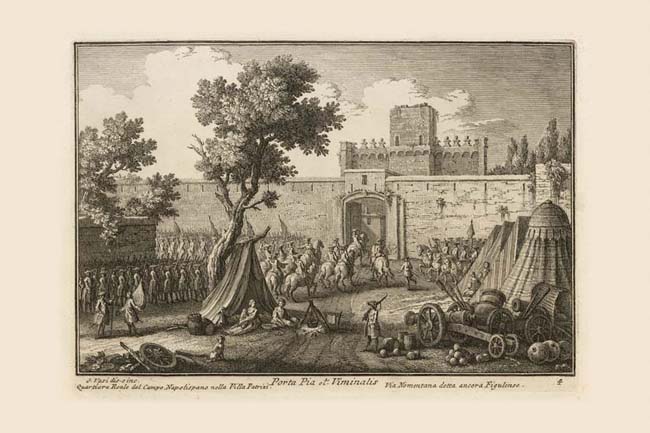
Porta Pia ol. Viminalis |
|
 |
|
 |
|
 |
|
| |
|
Porta Pia |
| |
a. |
Via Nomentana detta ancora Figulense |
| |
-. |
Villa Patrizi |
Porta Pia is not the ancient gate which spanned Via Nomentana. The nearby ancient gate (visible on the Nolli map marked with a star *) was walled up when Pius IV Medici straightened the ancient street known as Alta Semita along the ridge of the Quirinal hill, and cut a new opening in the Aurelian walls. That modest gate is what we see facing us in the Vasi print. Vasi shows the wall enclosure of the Villa Patrizi, Plate 191, in the left foreground framing what he refers to as the "Campo Napolispano." In 1851 it was replaced by a more elaborate structure designed by Vespignani. Behind it is the back of the elaborate gate facade turned toward the city, designed by Michelangelo in the early 1560s. The incomplete central element was finished by Vespignani in 1861. Flanking it, the "heads" of Michelangelo's anthropomorphic crenellations are the balls from the Medici coat of arms. Following his lead, Bernini used similar figures on Porta del Popolo, Plate 1. Bianchini, who wrote the text for only the first volume of the Magnificenze, writes that the parade of soldiers represents the 1744 entry into the city of the Charles III, King of the Two Sicilies, appropriately enough the personage to whom Vasi dedicated this first volume of the Magnificenze.
|
