| |
012. |
|
Porta Portese ol. Portuensis |
|
 |
|
 |
|
 |
|
| |
|
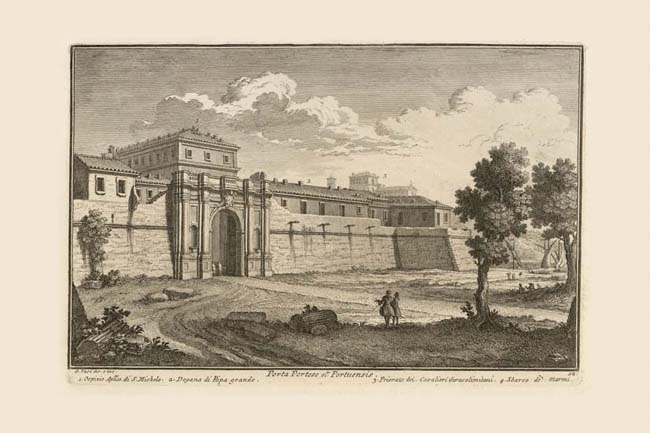
Porta Portese olim Portuensis |
| |
1. |
Ospizio Aplica di S Michele |
| |
2. |
Dogana di Ripa Grande |
| |
3. |
Priorato dei Cavalieri Gerosolimitani |
| |
4. |
Sbarco de' Marmi |
Porta Portese is the only instance where the later and earlier name for a gate correspond, the former being a corruption of the latter. But the placement of the two gates differs because the ancient one stood 453 meters further out on the Via Portuensis as is to be seen on the Nolli map which shows the lost section of the Aurelian walls in Trastevere (light grey, indicating Nolli's reconstruction). Vasi was aware of this difference because he devotes half of Plate 11A to his own reconstruction of the ancient gate which he labels: Esterno della Porta Portese antica deruta da Urbano VIII l'an. 1643 (exterior of the ancient Porta Portese destroyed by Urban VIII in 1643). This print depicts the new gate in the Baroque walls which were built under the same Pope. The gate was completed by Urban's successor Innocent X (1644-55) whose coat of arms appears above the arch. Like the considerably earlier Porta S. Spirito, Plate 15, the triumphal arch motif is the main element of the design by M.A. De Rossi. All the buildings which Vasi numbers on the print can be identified on the Nolli map: Ospizio delle donne in S. Michele (1), next to the Port of Ripa Grande; Dogana di Ripa Grande (2), customs house demolished in 1914; S. Maria del Priorato (3), Priory of the Knights of Malta, on the Aventine hill. The position of the river is signaled by the masts and sails of two boats (4) at far right which also are an indication of the nearby port of Ripa Grande, Plate 97 and Plate 98.
|
