| |
097. |
|
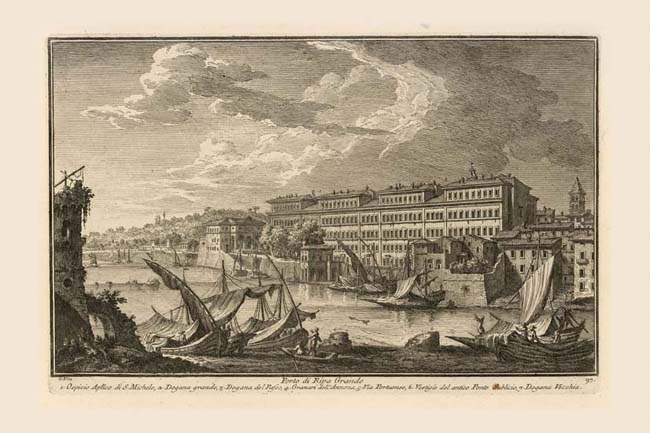
Porto di Ripa Grande |
|
 |
|
 |
|
 |
|
| |
1. |
Ospizio Aplico di S Michele |
| |
2. |
Dogana grande |
| |
3. |
Dogana del Passo |
| |
4. |
Granari dell'Annona |
| |
5. |
Via Portuense |
| |
6. |
Vestigie del antico Ponte Sublicio |
| |
7. |
Dogana Vecchia |
As its name implies, the Porto di Ripa Grande is the larger of Rome's two river ports the other being the Porto di Ripetta, Plate 85. Since the middle ages this Trastevere landing served boats bringing goods upstream from the sea. It was located directly across the river from the long defunct ancient river port at the foot of the Aventine hill. The port occupied the length of the river bank in front of the multi-section Ospizio Apostolico di S. Michele (1) Plate 98. Built in sequence between 1686 and 1735, the ospizio (hospice) housed a women's prison, a correctional facility for boys, a wool factory, a hospital and two churches. To the left of this long building is a porticoed structure named Dogana Grande (2) (Large Customs House) which served the port. The irregular cluster of buildings at the upstream end of the port was the old customs house (7). The small building raised on arches at the center of the port was customs house for handling wine identified by Vasi as the Dogana del Passo (3). The lack of organization and symmetry, the two unequal stairways from the river to street level, and the rough section of bank topped by trees, reveal that this port was developed irregularly over time, unlike the symmetrical and less extensive Porto di Ripetta. Behind the Dogana Grande can be seen the river end of the Baroque wall encompassing Trastevere, built under Urban VIII Barberini (1623-1644). The first gate in that wall, Porta Portese, Plate 12, not visible in this print, is to the right of the customs house. The Via Portuense (5) continues its path from the gate southward bounded by an arched building Arsenal, Plate 98, built under Clement XI Albani (1700-1721) and a papal granary (4). On the extreme right edge of the print we see the pointed bell-tower of S. Crisogono, Plate 119. In the foreground are visible the remains of the ancient Ponte Sublicio (6) which also appear in Plate 96. Further downstream in the river are other ancient remains indentified as such by Nolli (NN 1082) but not by Vasi.
|
