| |
046. |
|
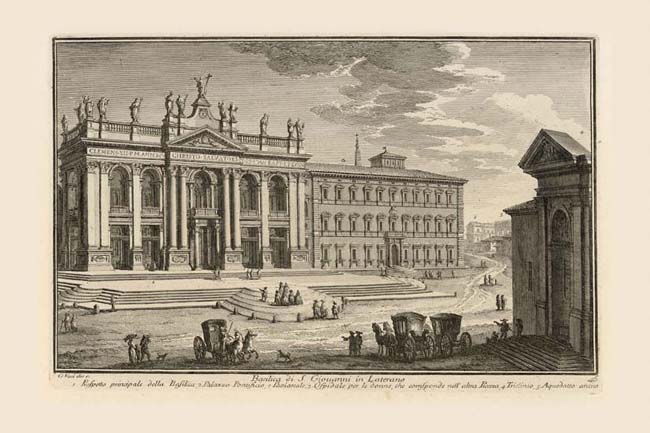
Basilica di S. Giovanni in Laterano |
|
 |
|
 |
|
 |
|
| |
1. |
Prospetto principale della Basilica |
| |
2. |
Palazzo Pontificio, e Patriarcale |
| |
3. |
Ospidale per le donne, chne corrisponde nell' altra Piazza |
| |
4. |
Triclinio |
| |
5. |
Aquedotto antico |
| |
-. |
Obelisco |
| |
-. |
Oratorio del Sagramento in S. Gio. Lat |
This great early Christian basilica, S. Giovanni in Laterano (1), has remained the seat of the Bishop of Rome since Constantine (306-337 AD) built it for Pope Silvestro I (314-35) on the site of the property of the Laterani, a wealthy Roman family (hence the "Laterano" in the name). Next to the church the same emperor also built the Patriarchium, or papal residence, which was demolished and replaced by the Palazzo Pontificio (2) by Domenico Fontana under Pope Sixtus V (1585-90). In this view we see the basilica's facade by Galilei (1735), the latest addition to the complex. The large inscription in the entablature informs us that the facade was commissioned by Clement XII (1730-40) and dedicated to the Saviour, whose statue tops the center of the facade, as well as to St. John the Baptist and St. John the Evangelist. Though this is the front entrance to the basilica, the transept entrance was the one most in use because it faced the processions approaching from the main part of the city along the Stradone S. Giovanni whose terminus is barely visible in this print between the Palazzo Pontificio and the women's section of the Ospedale di S. Giovanni (3). To the right of the latter we see three arches of the Neronian branch of the Claudian aqueduct (5); visible on the Nolli map, but unnumbered. Protruding above the Palazzo Pontificio we see the top of the obelisk in front of the transept facade of the basilica (see Plate 34). At the right edge of the print, the niche is the only surviving element of the Triclinium of Leo III (4) (795-816), another part of the Patriarchium demolished by Sixtus V. Vasi dedicates one of his four large prints of the Patriarchial Churches to S. Giovanni in Lateranno where it appears as a distant feature behind the Forum.
|
