|
| |
1. |
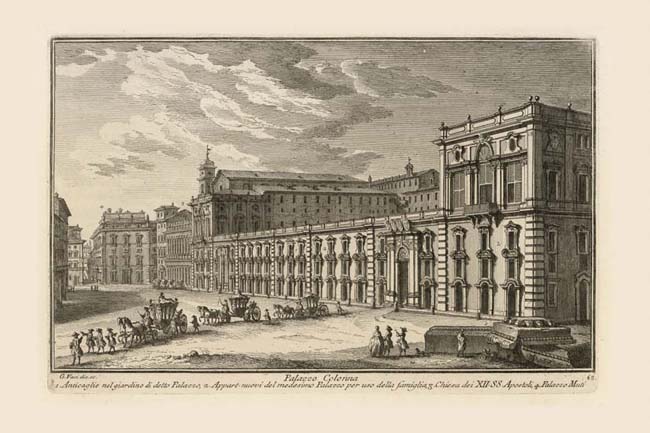
Anticaglia nel giardino di detto Palazzo
|
| |
2. |
Palazzo Colonna |
| |
3. |
Chiesa dei XII SS Apostoli |
| |
4. |
Palazzo Muti |
The Palazzo Colonna has been the residence of one of the most powerful noble families in the city since the middle ages, the period to which the core of this large holding dates. Facing on Piazza SS. Apostoli is the latest addition to the complex, a long wing built in 1730, which replaced the wall enclosing one side of the courtyard (see Falda map of 1676). The architecture is by Michetti, but only the two corner pavilions and portals remain unchanged, the central section having been considerably altered in the 19th century. The entrance portals were aligned on two streets entering the piazza, as clearly indicated on the Nolli map. The near portal shows a procession of carriages exiting from it. The relationship between the palazzo and the church is a close one, as occurred in other Roman examples of this type (see Plate 44, 74, 115). Martin V (1417-31), a Colonna Pope, restored SS. Apostoli (3) the early Christian church which formed part of the block dominated by his family. In the right foreground Vasi depicts fragments from entablature of the Temple of the Sun (1) actually located in the Colonna gardens on the hill behind the palazzo (NN 258) shown in a second view by Vasi from its garden side, Plates 193, and 193A. The comparatively small Palazzo Muti Papazzurri (4) at the far end of the piazza was the residence of Henry, Cardinal York (1725-1807), the last Stuart pretender to the throne of England. Facing Palazzo Colonna, and barely visible at the left edge of the print is the Palazzo Chigi-Odescalchi, shown in Vasi’s companion view of the Piazza SS. Apostoli, Plate 64.
|


