|
| |
|
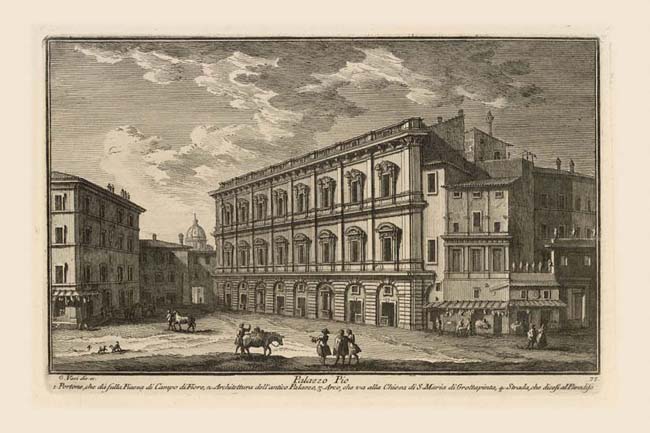
Palazzo Pio |
| |
1. |
Portone che da sulla Piazza Campo di Fiore |
| |
2. |
Architettura dell'antico Palazzo |
| |
3. |
Arco, che va alla Chiesa di S Maria di Grottapinta |
| |
4. |
Strada che dicesi al Paradiso |
Nolli refers to the Palazzo Pio in his index as Palazzo Pio con le ruine del Teatro di Pompeo (...with the ruins of the theater of Pompey) and to the the urban space in front of it as Piazza del Biscione (NN 637). "Biscione" (a large snake) gives the clue to the origins of the palazzo because it refers to the eel ("biscione" for the locals) in the coat of arms of the Orsini who turned the ruined 1st century BC theater into a medieval stronghold. After various accretions over time and changes of ownership, this facade element, one bay deep, was added by Arcucci in 1667, but was left incomplete as the unfinished arches at both ends reveal. At the obtuse-angled corner of the building on the right, had the incomplete arch been continued it would have cut into the still extant, protuberant part of the earlier structure (2) facing onto the contiguous view of the Campo de' Fiori, Plate 28. The open portal (3) next to the left end of the palazzo is the entrance to a covered passage leading to the curved Piazza di Grotta Pinta (a reference to the frescoes in the underground ruins of the theater) where the semi-circular shape of the original theater is clearly revealed in the buildings constructed over it. Above the portal Vasi shows an impossible view of the dome of the nearby S. Andrea della Valle, Plate 134. The open portal (1) on the extreme right edge of the print opens onto a court since filled in by a building currently serving as a movie theater. Trailing off the scene to the left, shows the Via Paradiso (4) heading toward the Palazzo Massimo, Plate 76.
|


