| |
076. |
|
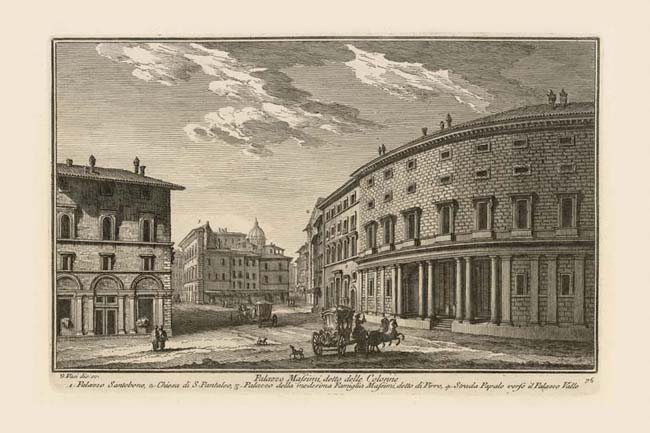
Palazzo Massimi, detto delle Colonne |
|
 |
|
 |
|
 |
|
| |
|
Palazzo Massimi, detto delle Colonne |
| |
1. |
Palazzo Santobono |
| |
2. |
Chiesa di S Pantaleo |
| |
3. |
Palazzo della medesima Famiglia Massimi, detto di Fippo |
| |
4. |
Strada Papale verso il Palazzo Valle |
The powerful Massimo family, which claimed descent from Fabius Maximus (an ancient hero of the Roman Republic), owned two contiguous palaces on the Via Papale (4) the papal processional way. The more famous one is the Palazzo Massimo alle Colonne, built by Peruzzi in the early 1530s over the ruins of an earlier Massimo building destroyed by fire in the 1527 sack of the city. Its name "alle Colonne" derives from the singular porch with paired columns at the center of the facade which is part of a continuous trabeation running its full width. Singular because no other urban palazzo in Renaissance Rome displayed this feature of a deep entrance porch opening onto the street. In order to place the main door to the palace on the axis of the facing Via del Paradiso (NN 628) and still retain symmetry for the facade, the Massimo extended their building onto the property of their relatives, the Massimo di Pirro (3). Thus the bay at the left end of the Colonne palace is only one room deep and shows up in plan as a bite taken out of the Pirro palace. Beyond the Palazzo Massimo di Pirro stands the tall unfinished facade of S. Pantaleo (2), reworked by Valadier in the early 19th century. Continuing to the right Vasi shows an impossible view (from this vantage point) of the narrow Vicolo della Cuccagna (NN 622) which leads to Piazza Navona. The Via Papale is shown passing to the left of the old Orsini block, owned at this time by the Caraccioli di Santobono (1) now Palazzo Braschi, on its way to Piazza di Pasquino, Plate 26A. The dome rising above this block is the dome of S. Agnese on Piazza Navona, Plate 26. At the left edge of the print, on the corner of Via del Paradiso, is Palazzo Manfroni, cut back and largely rebuilt in the late 19th century when the Corso Vittorio Emanuele II absorbed this section of the Via Papale.
|
