| |
107. |
|
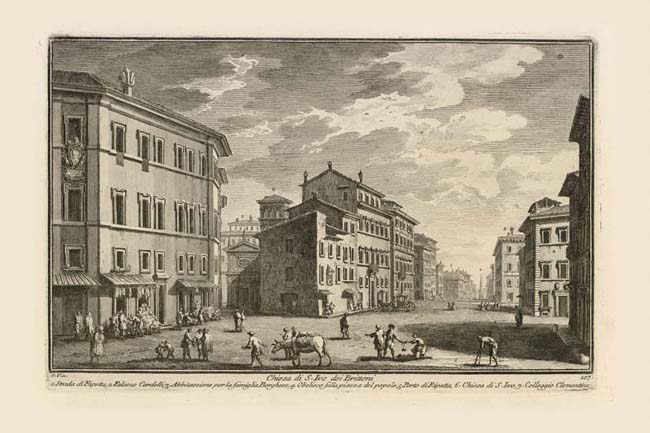
Chiesa di S. Ivo dei Brittoni |
|
 |
|
 |
|
 |
|
| |
1. |
Strada di Ripetta |
| |
2. |
Palazzo Cardelli |
| |
3. |
Abbitazione per la famiglia Borghese |
| |
4. |
Obelisco sulla Piazza del Popolo |
| |
5. |
Porto di Ripetta |
| |
6. |
Chiesa di S. Ivo |
| |
7. |
Collegio Clementino |
Tucked away in the narrow Vicolo della Campana (NN 505) is the rather insignificant church of St. Ives, national church of the Bretons (NN 504). In the late 19th century the 15th century church was totally rebuilt and reoriented 90° from the position we see here. Vasi uses this modest church as a pretext to depict the long Via della Scrofa/Ripetta (1), the left hand member of the trivium of Piazza del Popolo, whose obelisk (4) can be seen in the distance. Via Ripetta was named after the port of the same name, Plate 85, which is hidden off to the left of the customs house (5) site of the recent (2005) Ara Pacis building by Richard Meier. Next to St. Ives Vasi the Vicolo della Campana continues on to Piazza Nicosia marked by the Collegio Clementino (7) Plate 167. Before the long Ripetta axis was cut through the neighborhood in 1517, the vicolo and piazza were important local elements. The new street eclipsed the one and bypassed the other, turning both into urban backwaters. In the right middle ground we see the corner of the Palazzo Borghese per la famiglia (3) part of the large Borghese enclave illustrated in Plate 69. This building marks the beginning of the Via Trinititas cut through by Paul III Farnese (1534-1549). At the same intersection is Palazzo Cardelli (2) built in the late 16th century on the awkwardly shaped polygonal plot left over by the slicing effect on the neighborhood of the Via della Scrofa/Ripetta and Via Trinitatis.
|
