| |
126. |
|
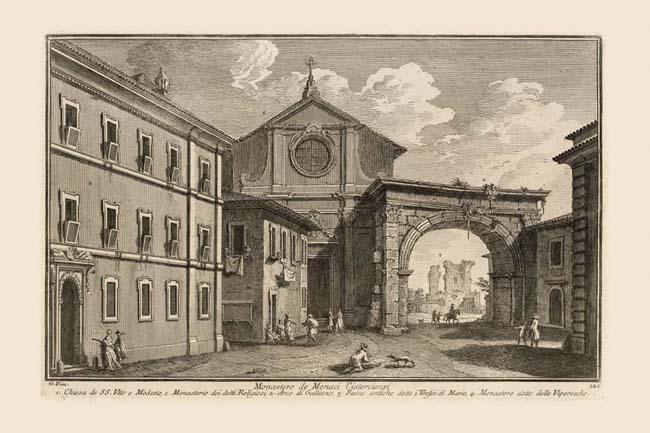
Monastero dei Monaci Cisterciensi |
|
 |
|
 |
|
 |
|
| |
1. |
Chiesa de SS. Vito e Modesto e Monasterio dei detti Religiosi |
| |
2. |
Arco di Gallieno |
| |
3. |
Ruine antiche dette I Trofei di Mario |
| |
4. |
Monastero dette delle Viperesche |
The ancient Arch of "Gallienus" (2) which dominates this print, is inscribed in the frieze with the name of that mid 3rd century emperor, but was actually built by Augustus (27 BC – 14 AD) as a replacement of the Esquiline gate in the Republican walls of the city. The gate spanned a pre-Roman pathway (later named Via Suburrana) which came from the east and led to what was to become the Forum. The arch was originally flanked by two smaller arches, the minimal remains of the left one being visible in Vasi's view. It frames another ancient ruin (3) in the distance, the mostra (terminal display) of the Julian aqueduct (shown in more detail in Plate 49) which originally took the form of a triumphal arch on a high base. The early Christian church of S. Vito (1) was restored in the 1470s by Sixtus IV della Rovere (1471-1484), whose name appears on the portal. Apart from that portal, the Baroque decoration on the facade was removed in the late 19th century, together with the little building which hides part of the church in the print. The monastery building of the Viperesche (4) flanks the scene on the left. In 1900 the church was reversed by placing a new facade and doorway against the apse so as to turn the church toward the newly developed area of Piazza Vittorio Emanuele II. In 1973 the church was returned to its original orientation.
|
