| |
127. |
|
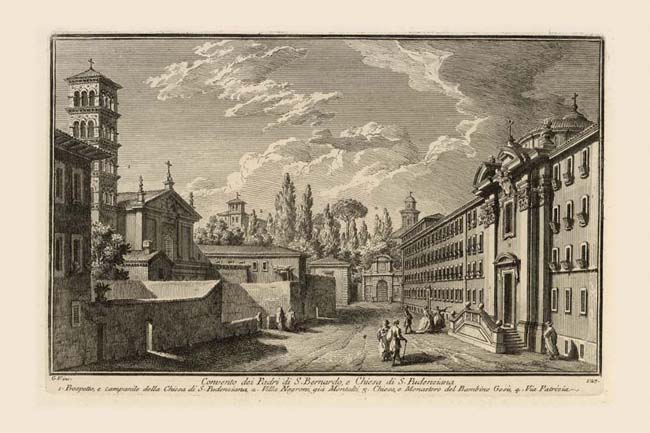
Convento dei Padri di S. Bernardo, e Chiesa di S. Pudenziana |
|
 |
|
 |
|
 |
|
| |
1. |
Prospetto e campanile della Chiesa di S. Pudenziana |
| |
2. |
Villa Negroni già Montalto |
| |
3. |
Chiesa e Monastero del Bambin Gesù |
| |
4. |
Via Patrizia
Via Patrizia
|
Vasi rarely mentions bell towers in his captions, but in this print he evidently wants to draw the viewer's attention to the finely drawn 12th century tower on the left, belonging to the early Christian church of S. Pudenziana (1). An atrium separates its facade from the street, a condition which is rare for Roman churches. There is no trace of a portico which must have surrounded this forecourt at one time. Using its ancient name of Vicus Patricius, Vasi labels the street Via Patrizia (4) while Nolli refers to it by its modern name: Via Urbana (NN 152), derived from its having been widened under Urban VIII Barberini (1623-1644). The street leads up to the main gate of the Villa Montalto/Negroni (2), which also had a gate on piazza di Termini at the Baths of Diocletian, Plate 194. The Nolli map shows three diverging paths leading from the gate in this view to the casino (main building) of the villa, whose altana (tower like belvidere) can be seen just above the gate. Villa Negroni was built by Cardinal Montalto who went on to become Pope Sixtus V (1585-1590). His villa adjoined S. Maria Maggiore, Plates 48, 122, to which he was particularly devoted. He commissioned Fontana to build a transept chapel for his tomb and later used the basilica as the center of a set of new roads radiating from it including Via Panisperna, Plate 152. The latter road intersects Via Urbana close to the point from which this view was taken. On the right we see the early 18th century church and monastery of Bambino Gesù (3).
|
