| |
197. |
|
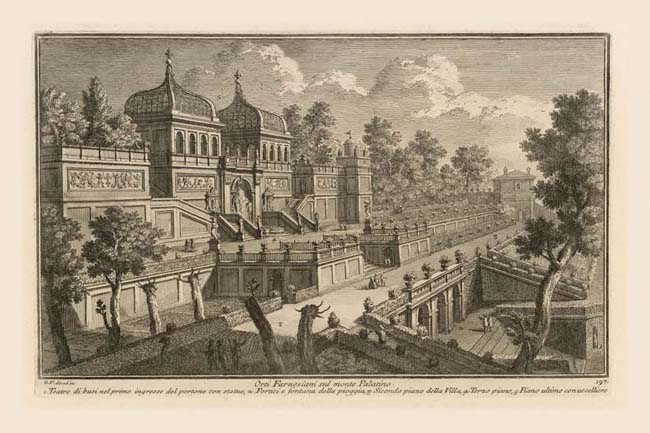
Orti Farnesiani sul monte Palatino |
|
 |
|
 |
|
 |
|
| |
1. |
Teatro di busi nel primo ingresso del portone con statue |
| |
2. |
Portici e fontana della pioggia |
| |
3. |
Sicondo piano della Villa |
| |
4. |
Terzo piano |
| |
5. |
Piano ultimo con ucelliere |
Another of Vasi's rare elevated views shows the terracing effect of the Orti Farnesiani designed by Vignola which Nolli calls the Villa Farnesiana. Since it did not have a casino, but only the two pavilions which Vasi refers to as uccelliere (5) (bird cages or aviaries) this does not really qualify as a villa. Thus Vasi's use of Orti (gardens) is more exact, though he does use "villa" in one of the captions. In fact the Farnese already had a suburban villa, known as the Farnesina, Plate 88A, across the river from Palazzo Farnese, Plate 73. In the mid 16th century Cardinal Alessandro Farnese started the long building process completed more than 50 years later by his great-nephew Cardinal Odoardo Farnese. Vasi does not depict the orti themselves, which covered about half the area of the top of the Palatine hill but Nolli shows them to their full extent. Vasi illustrates the elaborate terraces leading up to the orti from a gateway at the level of the Roman Forum. This entrance was just to the right of the semicircular statue-lined teatro (1) shown on the lower right. In his caption Vasi enumerates the levels, also referring to an underground fontana della pioggia (2) (rain fountain) behind the portico. From this fountain underground ramps lead up to the next level (3) where two figures can be seen emerging from a door next to the central ramp. The third level presents a yet another terrace with bifurcating staire in the manner of the Casino Pio IV, Plate 182. In the early 17th century the orti became the first botanical garden in Rome only to be largely demolished in the 19th century during extensive archeological excavations of the Palatine hill and the Roman Forum, Plates 32, 54. Although not exactly on the cross axis of the Basilica of Maxentius opposite, visually the twin pavilions, which are slightly splayed apart, appear to acknowledge its axis in general terms. Each pavilion provides a different prospect, one directed toward the Campidoglio the other inflected toward the Colosseum.
|
