Advancing Pediatric Care, Research and Training
 ince 1997, the Foundation has raised funds to ensure that Lucile Packard
Children’s Hospital and the pediatric programs at Stanford University School
of Medicine are able to provide the finest, family-centered care to children;
train the next generation of pediatric medical leaders; and conduct research into
treatments and cures for diseases that affect children throughout the world.
ince 1997, the Foundation has raised funds to ensure that Lucile Packard
Children’s Hospital and the pediatric programs at Stanford University School
of Medicine are able to provide the finest, family-centered care to children;
train the next generation of pediatric medical leaders; and conduct research into
treatments and cures for diseases that affect children throughout the world.
Growth in community support over the last decade has helped transform Packard Children’s into one of the nation’s top children’s hospitals, and has sustained its commitment to care for any child in the community, including those without health insurance.
In 2009, the Foundation reached $308 million toward its campaign goal of $500 million to help fund a planned expansion of Packard Children’s and to support education, training, and research at the School of Medicine. The Breaking New Ground Campaign was boosted by the generosity of the David and Lucile Packard Foundation, which will commit up to $100 million toward the Hospital expansion.
Half of this remarkable commitment is designated as a challenge to the philanthropic community to help raise the remaining $100 million needed to expand the current facility. The Packard match will be a 1:2 challenge, with every two dollars given by a donor earning one dollar of the grant.
The existing Hospital is operating well beyond its intended capacity, and growth will allow the Hospital to sustain its mission. The expansion eventually will double the Hospital’s size, adding much-needed surgical, diagnostic, and treatment rooms.
Overall in 2009, total donations for the Hospital and School were $69.2 million, thanks to the generosity of 8,599 individuals, foundations, and corporations.
Among the Packard Hospital and School of Medicine highlights for the year:
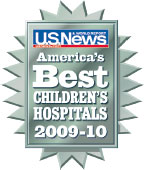
- Packard Children’s was once again ranked among the nation’s best pediatric medical centers. In its annual “America’s Best Children’s Hospitals” issue, U.S. News & World Report placed Packard #5 in neonatal care and heart and heart surgery. Additionally, six other programs, including cancer and neurosurgery, made the U.S. News Top 20.
- According to the United Network for Organ Sharing, in 2009 Packard Children’s was among the highest volume pediatric liver transplant centers in the nation. Packard researchers also identified biomarkers that allow doctors to predict which children who have received a liver transplant can withdraw from immunosuppressive drugs safely. The team’s bench-to- bedside expertise has made them a national leader in pediatric liver transplant.
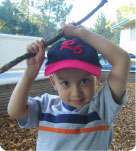
- After Mark Blinder was diagnosed with a rare bonecancer at age 3, orthopedic surgeon Lawrence Rinsky, MD, performed a limb preserving surgery that had never been attempted in a toddler. Nearly a year later, Mark is thriving with a surgically implanted artificial humerus inside his cancer-free right arm. He’s believed to be the first small child ever to receive a high-tech, telescoping prosthesis to replace the entire upper arm bone.
- Researchers at Packard and the Stanford School of Medicine shed light on the neural basis of memory defects in Down syndrome, suggesting a new strategy for treating kids with the condition. A study by Ahmad Saliehi, MD, PhD, found that boosting norepinephrine signaling may improve mental cognition. This finding suggests that if doctors intervene early enough, they may be able to help kids with Down syndrome to better collect and modulate information.
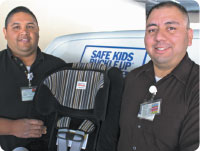
- In May, the Maggie Adalyn Otto Safely Home Car Seat Fitting Station at Packard Children’s reached a major milestone: installing its 10,000th car seat. Car seat specialists run the station seven days a week, free of charge. Their expert guidance ensures that families get the help they need to keep their kids safe on the road.
- Adolescent medicine specialist Sophia Yen, MD, identified the top sixteen sexual health myths perpetuated by 35 well-trafficked health websites. Yen’s study found that myths about birth control, sexually transmitted diseases, and health exams are not dispelled even on several sites reviewed by physicians. Media coverage of the study helped correct misinformation and brought attention to problems with finding sexual health answers online.
Hospital Auxiliaries
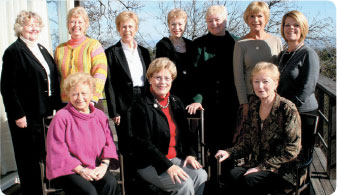
2009 Auxiliaries presidents
Seven community-based Auxiliaries operate businesses and stage benefit events to support uncompensated care and other special projects at Lucile Packard Children’s Hospital.
In 2009, the auxiliaries and their individual members donated more than $1.5 million. San Jose Auxiliary runs the Thrift Box and hosts Pumpkin Patch each fall; Allied Arts Guild Auxiliary operates Allied Arts Guild in Menlo Park and stages Tally Ho annually; Charter Auxiliary runs monthly rummage sales; Palo Alto Auxiliary manages many popular fundraisers, including American Girl Doll events; Roth Auxiliary manages and staffs the Gift Shop in Packard Children’s Hospital; San Mateo-Burlingame Auxiliary hosts special events; and the San Francisco Auxiliary presents the annual Jewel Ball gala.
In addition, the Association of Auxiliaries oversees the Auxiliaries Endowment which currently stands at $12.3 million. It comprises bequests from members of the all-volunteer Auxiliaries and their families. Since the endowment was formed in 1999, more than $4.5 million in payout has supported new Hospital programs, purchased equipment, funded major patient services and facilities, and endowed a fund honoring Harvey Cohen, MD, PhD, former chief of staff. In 2009, the Auxiliaries Endowment payout of $845,487 was directed toward a $5 million pledge to the Hospital’s Phase II expansion project.