
Elevating the Priority of Children
The Foundation explored new avenues for elevating the priority of children in 2012.
In April, thought leaders were convened in Washington, DC, to develop a range of scenarios about how children’s health and well being might fare over the next generations under varying conditions and policies.  These scenarios then were used as an organizing device for an Aspen Institute Children’s Forum in July, the first time an Aspen event has focused on children. The forum drew transformational philanthropists from across the country who embraced the idea of creating a national movement for children “unlike any that has been undertaken before.”
During 2012, the Foundation commissioned a demographic analysis of how California’s child population is changing, the implications of those changes for the health and well being of children, and why this is important to the state as a whole. 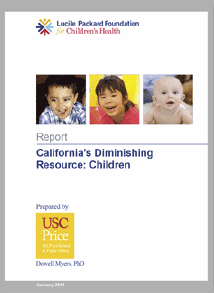 The report, California’s Diminishing Resource: Children, to be released in early 2013, provides support for the increasing importance
of health care, education, child care, and other services for children.
The report, California’s Diminishing Resource: Children, to be released in early 2013, provides support for the increasing importance
of health care, education, child care, and other services for children.
The Foundation also initiated a grant to HealthyCal.org, a Sacramento-based online news outlet that focuses on health policy, and is widely read by state policymakers. Dozens of stories on children’s health issues were written and distributed throughout California. A grant to the USC Annenberg School of Communications supported a training session for reporters in July on how to cover health, and sponsorship for two competitively selected media fellows to cover child health.
To better symbolize its work to elevate children, the Foundation also adopted a new logo. The yellow “child” in the graphic is being lifted, while the cheerful colors and starburst design signify optimism and energy for the task.
The Foundation continued to reap positive results from a five-year joint grant with Lucile Packard Children’s Hospital, which placed full-time nurses in schools in low-income areas of the San Jose Unified School District. Formal evaluation of the project documented improvements in student health screenings, referrals, emergency room visits, absenteeism, and academic scores. The program’s directors were invited to present their findings at two high-level conferences in Washington, DC, where it was featured as a model program.
Kidsdata.org, which provides data on child health and well being for all counties, cities, school districts and legislative districts in California, remained the mainstay of the Foundation’s work to bring attention to children. Over the course of the year, contextual information about why each topic is important was added, along with new indicators about child physical health and children with special health care needs. To keep pace with developing technology and assist users, an extensive upgrade of the site was initiated. The “search” function was enhanced, and groundwork was laid for other wide-ranging enhancements.
Staff continued to facilitate a data leadership role for the Foundation through ongoing participation in collaboratives such as California’s “Free the Data” initiative, which promotes better access to public data, Los Angeles County’s Children’s Data Network, and the national Health Data Consortium. Staff members also made more than two dozen presentations at conferences, convenings and briefings across the state on how to use kidsdata.org and how to use data generally for grant applications and program planning.
A small grants program to encourage organizations to use kidsdata.org and other data sources in their planning and work came to a successful conclusion in 2012.
More about the Foundation’s data and information programs is available at lpfch.org/programs.